Advertisements
Advertisements
प्रश्न
Give reason for the following:
Gases have a lower density compared to solids or liquids.
Advertisements
उत्तर
Gases have low densities as the inter-molecular distance between the molecules of gases is very large.
Pressure on the wall = `("Force exerted on the wall")/("Total area of the container wall")`
संबंधित प्रश्न
What is meant by aqueous tension? How is the pressure exerted by a gas corrected to account for aqueous tension?
Convert the following temperature from degree Celcius to kelvin.
−15° C
Convert the following pressure value into Pascals.
1 atmosphere
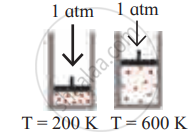
Identify the gas laws from the following diagram.
| Diagram | Gas laws |
 |
______________ |
With the help of the graph answer the following -
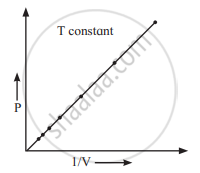
At constant temperature, the Graph shows the relationship between pressure and volume. Represent the relation mathematically.
State Boyle's law.
Name two items that can serve as a model for Gay Lusaac’s law and explain.
Give the mathematical expression that relates gas volume and moles.
Sulphur hexafluoride is a colourless, odourless gas; calculate the pressure exerted by 1.82 moles of the gas in a steel vessel of volume 5.43 dm3 at 69.5 °C, assuming ideal gas behaviour
If 2 moles of an ideal gas at 546 K has volume of 44.8 L, then what will be it's pressure? (R = 0.082)
