Advertisements
Advertisements
प्रश्न
Explain Why?
"When stating the volume of a gas, the pressure and temperature should also be given."
Advertisements
उत्तर
For a given volume of gas under given temperature and pressure, a change in any one of the variable i.e., pressure or temperature changes the volume.
APPEARS IN
संबंधित प्रश्न
State (i) the three variables for gas laws and (ii) SI units of these variables.
Convert the following temperature from degree Celcius to kelvin.
−197° C
Convert the following pressure value into Pascals.
107000 Nm−2
Convert 89 kPa to newton per square metre (Nm−2)
Consider a sample of a gas in a cylinder with a movable piston.
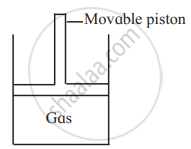
Show diagrammatically the changes in the position of the piston, if the temperature is decreased from 400 K to 300 K, and pressure is decreased from 4 bar to 3 bar.
Match the pairs of the following:
| Column ‘A’ | Column ‘B’ |
| a. Boyle’s law | i. at constant pressure and volume |
| b. Charles’ law | ii. at constant temperature |
| iii. at constant pressure |
Write the statement for Boyle’s law
Solve the following.
At 0°C, a gas occupies 22.4 liters. How much hot must be the gas in celsius and in kelvin to reach a volume of 25.0 liters?
Assertion: Critical temperature of CO2 is 304 K, it can be liquefied above 304 K.
Reason: For a given mass of gas, volume is to directly proportional to pressure at constant temperature
The volume of 400 cm3 chlorine gas at 400 mm of Hg is decreased to 200 cm3 at constant temperature. What is the new pressure of gas?
