Advertisements
Advertisements
प्रश्न
State (i) the three variables for gas laws and (ii) SI units of these variables.
Advertisements
उत्तर
- Three variables for gas laws: Volume (V), Pressure (P), Temperature (T)
- SI units of these variables:
For volume: Cubic metre (m3)
For pressure: Pascal (Pa)
For temperature: Kelvin (K)
APPEARS IN
संबंधित प्रश्न
Give reason for the following:
Gases have a lower density compared to solids or liquids.
Convert the following pressure value into Pascals.
1 atmosphere
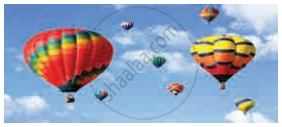
Hot air balloons float in the air because of the low density of the air inside the balloon. Explain this with the help of an appropriate gas law.
With the help of the graph answer the following -
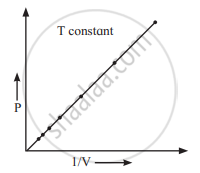
At constant temperature, Write the statement of law.
Solve the following.
A hot air balloon has a volume of 2800 m3 at 99°C. What is the volume if the air cools to 80°C?

Explain the following observation.
Liquid ammonia bottle is cooled before opening the seal
A small bubble rises from the bottom of a lake where the temperature and pressure are 6°C and 4 atm. to the water surface, where the temperature is 25°C and pressure is 1 atm. Calculate the final volume in (mL) of the bubble, if its initial volume is 1.5 mL.
According to Andrews isothermals at what temperature the carbon dioxide gas starts to condense at 73 atmosphere?
The volume of 400 cm3 chlorine gas at 400 mm of Hg is decreased to 200 cm3 at constant temperature. What is the new pressure of gas?
Identify the correct relationship between pressure (P), density (d), molar mass (M) and Temperature (T) for an ideal gas from the following.
