Advertisements
Advertisements
प्रश्न
A small bubble rises from the bottom of a lake where the temperature and pressure are 6°C and 4 atm. to the water surface, where the temperature is 25°C and pressure is 1 atm. Calculate the final volume in (mL) of the bubble, if its initial volume is 1.5 mL.
Advertisements
उत्तर
T1 = 6°C + 273 = 279 K
P1 = 4 atm
V1 = 1.5 ml
T2 = 25°C + 273 = 298 K
P2 = 1 atm
V2 = ?
`("P"_1"V"_1)/("T"_1) = ("P"_2"V"_2)/("T"_2)`
V2 = `("P"_1"V"_1)/("T"_1) xx "T"_2/"P"_2`
= `(4 "atm" xx 1.5 "ml" xx 298 "K")/(279 "K" xx 1 "atm")`
V2 = 6.41 ml
APPEARS IN
संबंधित प्रश्न
Answer in one sentence.
A bubble of methane gas rises from the bottom of the North sea. What will happen to the size of the bubble as it rises to the surface?
Convert the following temperature from degree Celcius to kelvin.
273° C
Convert the following pressure value into Pascals.
1 kPa
Convert the following pressure value into Pascals.
107000 Nm−2
Convert 0.124 torr to the standard atmosphere
Consider a sample of a gas in a cylinder with a movable piston.
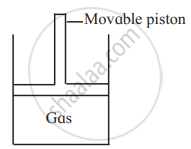
Show diagrammatically the changes in the position of the piston, if pressure is increased from 1.0 bar to 2.0 bar at a constant temperature.
With the help of the graph answer the following -
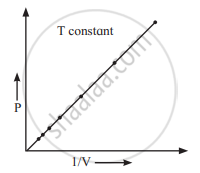
At constant temperature, the Graph shows the relationship between pressure and volume. Represent the relation mathematically.
Give the mathematical expression that relates gas volume and moles.
Explain the following observation.
The size of a weather balloon becomes larger and larger as it ascends up to larger altitude
A certain mass of a gas occupies a volume of 2 dm3 at STP. At what temperature the volume of gas becomes double, keeping the pressure constant?
