Advertisements
Advertisements
Questions
Will current flow more easily through a thick wire or a thin wire of the same material, when connected to the same source? Why?
Will current flow more easily through a thick wire or a thin wire of the same material when connected to the same source? Give reason for your answer.
Advertisements
Solution 1
The current will flow more easily through thick wire. It is because the resistance of a
conductor is inversely proportional to its area of cross-section. If thicker the wire, less is resistance and hence more easily the current flows.
Solution 2
Resistance (R) is inversely proportional to the area of the cross-section (A) of the
wire. So, thicker the wire, lower is the resistance of the wire and vice-versa.
Therefore, current can flow more easily through a thick wire than a thin wire.
`R = rho xx l/A`
`R ∝ 1/A`
Solution 3
The resistance of a conductor is inversely proportional to its area of cross-section, i.e. `R ∝ 1/A`. So as the conductor is a thick wire, its resistance decreases and current will flow easily through it, in comparison with a thin wire.
APPEARS IN
RELATED QUESTIONS
What is an Ohmic resistor?
Write the formula of resistivity
When a 12 V battery is connected across an unknown resistor, there is a current of 2.5 mA in the circuit. Calculate the value of the resistance of the resistor.
Keeping the p.d. constant, the resistance of a circuit is halved. The current will become:
(a) one-fourth
(b) four time
(c) half
(d) double
The resistors R1, R2, R3 and R4 in the figure given below are all equal in value.
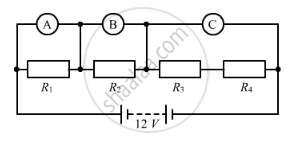
What would you expect the voltmeter A, B and C to read assuming that the connecting wires in the circuit have negligible resistance?
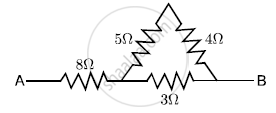
Calculate the effective resistance across AB?
A metal sphere is kept on an insulting stands. A negatively charged rod is brought near it, then the sphere is earthed as shown. On removing the earthing, and taking the negatively charged rod away, what will be the nature of charge on the sphere? Give reason for your answer.

What is non-ohmic resistor?
What are non-ohmic conductors? Give one exmaple. Draw a current-voltage graph for a non-ohmic conductor.
Draw a neat diagram for the verification of Ohm’s law by voltmeter-ammeter method. By another diagram show the relation between p.d. and current.
The ratio of the potential difference to the current is known as ________.
Explain the equivalent resistance of a series resistor network.
Explain the equivalent resistance of a parallel resistor network.
An electronics hobbyist is building a radio which requires 150 Ω in her circuit, but she has only 220 Ω, 79 Ω, and 92 Ω resistors available. How can she connect the available resistors to get the desired value of resistance?
The temperature of a conductor is increased. The graph best showing the variation of its resistance is:
A student carries out an experiment and plots the V-I graph of three samples of nichrome wire with resistances R1, R2 and R3 respectively. Which of the following is hue?

A heater of 220 V heats a volume of water m 5 mint time. A heater of 110 V heat in ten second. The resistance of the conductor is
Ohm's law deals with the relationship between ______
How is electric current related to the potential difference across the terminals of a conductor?
Draw a labelled circuit diagram to verify this relationship.
A current of 0.8 A flows in a conductor of 40 Ω for 1 minute. The heat produced in the conductor will be ______.
