Advertisements
Advertisements
Question
When did the narrator find that the boy was badly wounded?
Advertisements
Solution
Soon after the boy disclosed the conquest of Ratisbon and his glorious role in perching the French flag, Napoleon found that the boy was wounded.
APPEARS IN
RELATED QUESTIONS
Have you ever visited a fort or a castle?
How did the enemies enter the castle?
Bring out the contrasting picture of the castle as depicted in stanzas 3 and 5.
Our only enemy was gold
Identify the figure of speech used in the following line.
A little wicked wicket gate.
You visit your school after several years. As you cross the banyan tree at the entrance, cheerful memories fi ll your mind. Fill the bubbles with your memories.

What has Wordsworth sanctified in his poem?
Read the line given below and answer the question that follow.
A creeper climbs, in whose embraces bound No other tree could live.
- Which tree is referred to in the above lines?
- How does the tree survive the tight hold of the creeper?
- Why does Toru Dutt use the expression ‘a creeper climbs’?
How does a man play a lover’s role?
Explain the following line briefly with reference to the context.
“They have their exits and their entrances;
And one man in his time plays many parts,”
Pick out the word in ‘alliteration’ in the following line.
“and all the men and women merely players”
Read the given line and answer the question that follow.
Then the whining school-boy, with his satchel
And shining morning face, creeping like snail
Unwillingly to school.
- Which stage of life is being referred to here by the poet?
- What are the characteristics of this stage?
- How does the boy go to school?
- Which figure of speech has been employed in the second line?
Describe the various stages of a man’s life picturised in the poem “All the World’s a stage."
Introduction
The poem ‘Ulysses’ is a dramatic monologue that contains 70 lines of blank verse. Ulysses, the King of Ithaca, gathers his men together to prepare for the journey and exhorts them not to waste their time left on earth. Ulysses has grown old, having experienced many adventures at the battle of Troy and in the seas. After returning to Ithaca, he desires to embark upon his next voyage. His inquisitive spirit is always looking forward to more and more of such adventures.
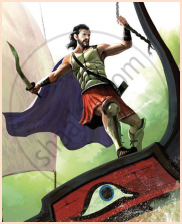
What has Ulysses gained from his travel experiences?
Read the set of line from the poem and answer the question that follow.
Little remains: but every hour is saved
From that eternal silence, something more,
A bringer of new things; and vile it were
- How is every hour important to Ulysses?
- What does the term ‘Little remains’ convey?
Read the set of line from the poem and answer the question that follow.
One equal temper of heroic hearts,
Made weak by time and fate, but strong in will
To strive, to seek, to find, and not to yield.
- Though made weak by time and fate, the hearts are heroic. Explain.
- Pick out the words in alliteration in the above lines.
Explain with reference to the context the following line.
I am become a name; For always roaming with a hungry heart
Explain with reference to the context the following line.
To follow knowledge like a sinking star,
Beyond the utmost bound of human thought.
What is Ulysses’ clarion call to his sailors? How does he inspire them?
Fill in the blanks choosing the words from the box given and complete the summary of the poem.
Lines 1-25
The poet Carl Sandburg gives a vivid description of a father’s worldly (1)______ in directing a son who is at the threshold of his (2) ______.
Here the father motivates his son to be like a hard(3) ______and withstand life’s (4)______ and sudden betrayals. (5)______is like a fertile soil. We can make our life fruitful if we are gentle, and take life as it comes. At times(6)______ overtakes harshness. The growth of a (7)______can split a rock. One should have a (8) ______and strong will to achieve. Greed for(9)______has left men dead before they really die. Good men also have fallen prey in quest for (10) ______money. Time for (11)______is not a waste. When you seek knowledge never feel ashamed to be called a(12)______for not knowing, at the same time learn from your (13) ______and never (14)______it.
| deep desire | manhood | gentleness | mistakes | easy |
| leisure | fool | life | money | repeat |
| tender-flower | rock | challenges | wisdom |
Lines 26-44
Do (15)______often, and do not hesitate to accept your shortcomings, avoid(16) ______to protect self against other people. Solitude helps to be (17)______and(18) ______ are taken in silent rooms. Instead of being one among many, be (19)______, if that is your nature. The son may need lazy days to find his (20)______abilities, to seek what he is born for. He will then know how free imaginations bring (21)______to the world, which (22)______ change. During such resentment, let him know that it is time for him to be on his own, and (23)______to achieve like Shakespeare, the Wright brothers, Pasteur, Pavlov, and Michael Faraday.
| changes | introspect | inherent | work | resents |
| white lies | creative | final decisions | different |
What has twisted good men into thwarted worms?
Explain the following line with reference to the context.
and guide him among sudden betrayals
and tighten him for slack moments.
Explain the following line with reference to the context.
Yet learning something out of every folly
hoping to repeat none of the cheap follies
Have you played chess or watched the game carefully?
Now identify the chess pieces and complete the table below. Discuss the role of each piece in the game.
 |
|
 |
|
 |
|
 |
|
 |
|
 |
Who do you think is the narrator of the poem?
Where did the rider plant the French flag after Ratisbon was captured?
Read the line given below and answer the question that follow.
A film the mother eagles eye When her bruised eaglet breathes
- Who is compared to the mother eagle in the above lines?
- Explain the comparison.
Explain the following line with reference to the context.
‘I’m killed, Sire!’ And, his Chief beside, Smiling, the boy fell dead.
