Advertisements
Advertisements
Question
Explain the following line briefly with reference to the context.
“Jealous in honour, sudden and quick in quarrel,
Seeking the bubble reputation”.“They have their exits and their entrances;
Advertisements
Solution
- Reference: These lines are from the poem ‘All the world’s a stage’ written by William Shakespeare.
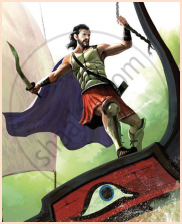
- Context and Explanation: The poet says these words while describing the fourth stage when the young man becomes a soldier and runs after short-lived glory. He has an inflated sense of honor and ready to insist on duels to settle matters touching his honor. He does not realize that the reputation he seeks is short-lived like a bubble.
APPEARS IN
RELATED QUESTIONS
Who is the narrator in the poem?
Why does the narrator say that the enemy was no threat at all?
Identify the figure of speech used in the following line.
How can this shameful tale be told?
Name the bird that sings in the poet’s garden.
Describe the reminiscences of the poet, when she sees the casuarina tree.
Pick out the word in ‘alliteration’ in the following line.
“and all the men and women merely players”
Pick out the word in ‘alliteration’ in the following line.
“And one man in his time plays many parts”
Read the given line and answer the question that follow.
Then a soldier,
full of strange oaths, and bearded like the pard,
Jealous in honour, sudden and quick in quarrel,
Seeking the bubble reputation
Even in the cannon's mouth.
- What is the soldier ready to do?
- Explain ‘bubble reputation’.
- What are the distinguishing features of this stage?
Describe the various stages of a man’s life picturised in the poem “All the World’s a stage."
Introduction
The poem ‘Ulysses’ is a dramatic monologue that contains 70 lines of blank verse. Ulysses, the King of Ithaca, gathers his men together to prepare for the journey and exhorts them not to waste their time left on earth. Ulysses has grown old, having experienced many adventures at the battle of Troy and in the seas. After returning to Ithaca, he desires to embark upon his next voyage. His inquisitive spirit is always looking forward to more and more of such adventures.
Complete the summary of the poem, choosing words from the list given below. Lines 1 to 32
Ulysses is (1) ______to discharge his duties as a (2) ______, as he longs for (3) ______. He is filled with an (4) ______thirst for (5) ______and wishes to live life to the (6) ______. He has travelled far and wide gaining (7) _______ of various places, cultures, men and (8) ______. He recalls with delight his experience at the battle of Troy. Enriched by his (9) ______he longs for more and his quest seems endless. Like metal which would (10) ______if unused, life without adventure is meaningless. According to him living is not merely (11) ______to stay alive. Though old but zestful, Ulysses looks at every hour as a bringer of new things and yearns to follow knowledge even if it is (12)______.
| fullest, unquenchable, unattainable, experience, knowledge, king, matters, rust, adventure, unwilling, travel, breathing |
Why did Ulysses want to hand over the kingdom to his son?
In what ways were Ulysses and his mariners alike?
What could be the possible outcomes of their travel?
Identify the figure of speech employed in the following line.
Thro’ scudding drifts the rainy Hyades Vext the dim sea...
Identify the figure of speech employed in the following line.
For always roaming with a hungry heart
Explain with reference to the context the following line.
I cannot rest from travel: I will drink Life to the lees:
Explain with reference to the context the following line.
How dull it is to pause, to make an end,
To rust unburnished, not to shine in use!
Explain with reference to the context the following line.
....you and I are old;
Old age hath yet his honour and his toil;
What is Ulysses’ clarion call to his sailors? How does he inspire them?
Fill in the blanks choosing the words from the box given and complete the summary of the poem.
Lines 1-25
The poet Carl Sandburg gives a vivid description of a father’s worldly (1)______ in directing a son who is at the threshold of his (2) ______.
Here the father motivates his son to be like a hard(3) ______and withstand life’s (4)______ and sudden betrayals. (5)______is like a fertile soil. We can make our life fruitful if we are gentle, and take life as it comes. At times(6)______ overtakes harshness. The growth of a (7)______can split a rock. One should have a (8) ______and strong will to achieve. Greed for(9)______has left men dead before they really die. Good men also have fallen prey in quest for (10) ______money. Time for (11)______is not a waste. When you seek knowledge never feel ashamed to be called a(12)______for not knowing, at the same time learn from your (13) ______and never (14)______it.
| deep desire | manhood | gentleness | mistakes | easy |
| leisure | fool | life | money | repeat |
| tender-flower | rock | challenges | wisdom |
Lines 26-44
Do (15)______often, and do not hesitate to accept your shortcomings, avoid(16) ______to protect self against other people. Solitude helps to be (17)______and(18) ______ are taken in silent rooms. Instead of being one among many, be (19)______, if that is your nature. The son may need lazy days to find his (20)______abilities, to seek what he is born for. He will then know how free imaginations bring (21)______to the world, which (22)______ change. During such resentment, let him know that it is time for him to be on his own, and (23)______to achieve like Shakespeare, the Wright brothers, Pasteur, Pavlov, and Michael Faraday.
| changes | introspect | inherent | work | resents |
| white lies | creative | final decisions | different |
Here are a few poetic device used in the poem.
Transferred Epithet- It is a figure of speech in which an epithet grammatically qualifies a noun other than the person or a thing, it is actually meant to describe.
Read the line given below and answer the question that follow.
“Life is a soft loam; be gentle; go easy.” And this too might serve him.
- Why does the poet suggest to take life easy?
- Identify the figure of speech in the above line.
Pick out the alliterated words from the poem and write.
And this might stand him for the storms
Who took the city of Ratisbon by storm?
Who came galloping on a horse to Napoleon?
What does the phrase ‘full galloping’ suggest?
Why was the rider in a hurry?
