Advertisements
Advertisements
Question
Read the set of line from the poem and answer the question that follow.
That ever with a frolic welcome took
The thunder and the sunshine, and opposed
- What do ‘thunder’ and ‘sunshine’ refer to?
- What do we infer about the attitude of the sailors?
Advertisements
Solution
- Thunder and sunshine refer to misfortunes and happy days. Ulysses and his comrades had undergone both kinds of experiences.
- The sailors shared the undying quest for exploration, adventure and for seeking newer knowledge in the untravelled world. They even welcomed dangers in fighting with Gods. They enjoyed the thrill of action and never worried about the outcome of battles or quests. They have an equal temper of heroic hearts.
APPEARS IN
RELATED QUESTIONS
Have you ever visited a fort or a castle?
Who is the narrator in the poem?
Why were the secret galleries bare?
Read the poem again and complete the summary using the words given in box.
Stanzas 1–3
‘The Castle’ by Edwin Muir is a moving poem on the (1)______ of a well guarded (2)______ The soldiers of the castle were totally stress-free and relaxed. They were (3)______ of their castle’s physical strength. Through the turrets they were able to watch the mowers and no enemy was found up to the distance of (4)______ and so they seemed no threat to the castle. They had (5)______ of weapons to protect them and a large quantity of (6)______ in stock to take care of the well-being of the soldiers inside the castle. The soldiers stood one above the other on the towering battlements (7)______ to shoot the enemy at sight. They believed that the castle was absolutely safe because their captain was (8)______ and the soldiers were loyal.
| half-a-mile | watching |
| castle | brave |
| ration | capture |
| plenty | confident |
Stanzas 4–6
Even by a trick no one but the birds could enter. The enemy could not use a (9)______ for their entry inside the castle. But there was a wicket gate guarded by a (10) ______ He (11)______ in the enemies inside the famous citadel that had been known for its secret gallery and intricate path. The strong castle became(12)______ and thin because of the greedy disloyal warder. The (13)______ was captured by the enemies for (14)______ The narrator (15)______ over the (16)______ of the useless warder and also decided not to disclose this (17)______ story to anyone. He was (18)______ and wondered how he would keep this truth to himself. He regretted not finding any (19)______ to fight with the (20)______ called ‘gold’.
| lamented | shameful |
| wicked guard | bait |
| let | gold |
| weapon | citadel |
| weak | disloyalty |
| helpless | enemy |
Bring out the contrasting picture of the castle as depicted in stanzas 3 and 5.
Read the given line and answer the question that follow in a line or two.
A foothold there, no clever trick
Could take us dead or quick,
Only a bird could have got in.
- What was challenging?
- Which aspect of the castle’s strength is conveyed by the above line?
Read the given line and answer the question that follow in a line or two.
We could do nothing, being sold.
- Why couldn’t they do anything?
- Why did they feel helpless?
Underline the alliterated word in the following line.
A little wicked wicket gate.
Name the bird that sings in the poet’s garden.
To whom does Toru Dutt want to consecrate the tree’s memory?
Read the line given below and answer the question that follow.
“Fear, trembling Hope, and Death, the skeleton,
And Time the shadow”, and though weak the verse
That would thy beauty fain, oh, fain rehearse,
May Love defend thee from oblivion’s curse.
- What does the poet mean by the expression ‘May love defend thee from oblivion’s curse?’
- What does the expression ‘fain’ convey?
- What does the poet convey through the expression ‘Fear, trembling Hope’?
Bring out the features of the fourth stage of a man as described by the poet.
Read the given line and answer the question that follow.
Then a soldier,
full of strange oaths, and bearded like the pard,
Jealous in honour, sudden and quick in quarrel,
Seeking the bubble reputation
Even in the cannon's mouth.
- What is the soldier ready to do?
- Explain ‘bubble reputation’.
- What are the distinguishing features of this stage?
Introduction
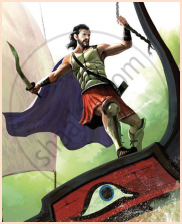
The poem ‘Ulysses’ is a dramatic monologue that contains 70 lines of blank verse. Ulysses, the King of Ithaca, gathers his men together to prepare for the journey and exhorts them not to waste their time left on earth. Ulysses has grown old, having experienced many adventures at the battle of Troy and in the seas. After returning to Ithaca, he desires to embark upon his next voyage. His inquisitive spirit is always looking forward to more and more of such adventures.
Complete the summary of the poem, choosing words from the list given below. Lines 33 to 42
Ulysses desires to hand over his (1) ______to his son Telemachus, who would fulfil his duties towards his subjects with care and (2) ______. Telemachus possesses patience and has the will to civilise the citizens of Ithaca in a (3) ______way. Ulysses is happy that his son would do his work blamelessly and he would pursue his (4) ______for travel and knowledge.
| prudence, kingdom, quest, tender |
Pick out the lines which convey that his quest for travel is unending.
What could be the possible outcomes of their travel?
Identify the figure of speech employed in the following line.
And drunk delight of battle with my peers;
Read the set of line from the poem and answer the question that follow.
Death closes all: but something ere the end,
Some work of noble note, may yet be done,
Not unbecoming men that strove with Gods.
- The above lines convey the undying spirit of Ulysses. Explain.
- Pick out the words in alliteration in the above lines.
Read the set of line from the poem and answer the question that follow.
One equal temper of heroic hearts,
Made weak by time and fate, but strong in will
To strive, to seek, to find, and not to yield.
- Though made weak by time and fate, the hearts are heroic. Explain.
- Pick out the words in alliteration in the above lines.
Explain with reference to the context the following line.
....you and I are old;
Old age hath yet his honour and his toil;
What happened to the people who wanted too much money?
Where are the final decisions taken?
Why does the poet advise his son to have lazy days?
Here are a few poetic device used in the poem.
Repetition- It is a figure of speech.
How did the young soldier face his end?
Explain the following line with reference to the context.
‘I’m killed, Sire!’ And, his Chief beside, Smiling, the boy fell dead.
Napoleon was a great source of inspiration to his army. Justify.
