Advertisements
Advertisements
Question
Explain with reference to the context the following line.
He works his work, I mine.
Advertisements
Solution
- Reference: These lines are from the poem ‘Ulysses” written by Alfred Tennyson.
- Context and Explanation: The poet says these words while justifying the decision of Ulysses to pass on his kingdom to Telemachus. Ulysses explains the polar difference between himself and his son Telemachus. His son will be a ‘fair’ and ‘decent’ ruler. Unlike Ulysses, Telemachus is rooted in regular political life. He enjoys leading the “savage” population and the responsibility of showing the subject better moral codes of conduct and upholding justice. Whereas Ulysses finds this “slow” and intolerable. So, he wishes his son to rule Ithaca and for himself, he wishes to set sail to the unknown.
APPEARS IN
RELATED QUESTIONS
Have you ever visited a fort or a castle?
Did the soldiers fight with the enemies face to face?
Who was the real enemy?
I will maintain until my death
What has Wordsworth sanctified in his poem?
Read the line given below and answer the question that follow.
“Fear, trembling Hope, and Death, the skeleton,
And Time the shadow”, and though weak the verse
That would thy beauty fain, oh, fain rehearse,
May Love defend thee from oblivion’s curse.
- What does the poet mean by the expression ‘May love defend thee from oblivion’s curse?’
- What does the expression ‘fain’ convey?
- What does the poet convey through the expression ‘Fear, trembling Hope’?
Identify the figure of speech used in each of the extract given below and write down the answer in the space given below.
“ A creeper climbs, in whose embraces bound
No other tree could live. But gallantly
The giant wears the scarf, and flowers are hung......”
What is the first stage of a human’s life?
Which stage of man’s life is associated with the ‘shrunk shank’?
Why is the last stage called second childhood?
Describe the various stages of a man’s life picturised in the poem “All the World’s a stage."
Introduction
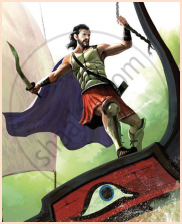
The poem ‘Ulysses’ is a dramatic monologue that contains 70 lines of blank verse. Ulysses, the King of Ithaca, gathers his men together to prepare for the journey and exhorts them not to waste their time left on earth. Ulysses has grown old, having experienced many adventures at the battle of Troy and in the seas. After returning to Ithaca, he desires to embark upon his next voyage. His inquisitive spirit is always looking forward to more and more of such adventures.
What does he think of the people of his kingdom?
What does Ulysses yearn for?
How would Telemachus transform the subjects?
Identify the figure of speech employed in the following line.
And drunk delight of battle with my peers;
Read the set of line from the poem and answer the question that follow.
Yet all experience is an arch wherethrough
Gleams that untravelled world, whose margin fades
For ever and for ever when I move
- What is experience compared to?
- How do the lines convey that the experience is endless?
Read the set of line from the poem and answer the question that follow.
Death closes all: but something ere the end,
Some work of noble note, may yet be done,
Not unbecoming men that strove with Gods.
- The above lines convey the undying spirit of Ulysses. Explain.
- Pick out the words in alliteration in the above lines.
Read the set of line from the poem and answer the question that follow.
One equal temper of heroic hearts,
Made weak by time and fate, but strong in will
To strive, to seek, to find, and not to yield.
- Though made weak by time and fate, the hearts are heroic. Explain.
- Pick out the words in alliteration in the above lines.
Explain with reference to the context the following line.
To follow knowledge like a sinking star,
Beyond the utmost bound of human thought.
Explain with reference to the context the following line.
The long day wanes: the slow moon climbs:
the deep Moans round with many voices.
Explain with reference to the context the following line.
It may be we shall touch the Happy Isles,
And see the great Achilles, whom we knew.
What is Ulysses’ clarion call to his sailors? How does he inspire them?
Pick out the alliterated words from the poem and write.
And this might stand him for the storms
Explain the following line with reference to the context.
Yet learning something out of every folly
hoping to repeat none of the cheap follies
Explain the following line with reference to the context.
Brutes have been gentled where lashes failed.
Fill in the blanks choosing the words from the box given and complete the summary of the poem.
The poet Robert Browning narrates an incident at the French Camp in the war of 1809 between France and Austria, in a (a)______version. He describes the brave action of a (b)______soldier, whose heroic devotion to duty and his (c) ______ in it is inspiring and worthy of (d) ______. During the attack of the French army on Ratisbon, Napoleon was anxious about the (e) ______. Austrians were defending Ratisbon with great (f) ______and courage. Napoleon was watching the war standing on a (g) ______near the battlefield.
All of a sudden a rider appeared from the closed smoke and dust. Riding at great speed, jumping and leaping, he approached the mound where Napoleon stood. As he came closer, the narrator noticed that the rider, a young boy, was severely wounded. But the rider showed no sign of pain and smiling in joy, jumped off the horse and gave the happy news of (h) ______to the emperor.
He exclaimed with pride that the French had (i) ______Ratisbon and he himself had hoisted the flag of France. When Napoleon heard the news, his plans (j) ______up like fire. His eyes (k) ______when he saw that the soldier was severely wounded. Like a caring mother eagle, the emperor asked if he was wounded. The (l) ______soldier replied proudly that he was killed and died heroically.
| determination | result | dramatic |
| pride | admiration | softened |
| wounded | mound | victory |
| conquered | soared | valiant |
What does the phrase ‘full galloping’ suggest?
