Advertisements
Advertisements
Question
Introduction
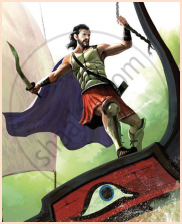
The poem ‘Ulysses’ is a dramatic monologue that contains 70 lines of blank verse. Ulysses, the King of Ithaca, gathers his men together to prepare for the journey and exhorts them not to waste their time left on earth. Ulysses has grown old, having experienced many adventures at the battle of Troy and in the seas. After returning to Ithaca, he desires to embark upon his next voyage. His inquisitive spirit is always looking forward to more and more of such adventures.
Advertisements
Solution
The poem can be divided into three parts
- the thirst for adventure, which does not allow Ulysses to remain in his kingdom as a mere ruler;
- Ulysses handing over the responsibility to his son Telemachus, with total confidence in his abilities;
- Ulysses’ clarion calls to his sailors, urging them to venture into unknown lands.
APPEARS IN
RELATED QUESTIONS
How long had the soldiers been in the castle?
Where were the enemies?
Our captain was brave and we were true
Underline the alliterated word in the following line.
The wizened warder let them through.
Identify the figure of speech used in the following line.
A little wicked wicket gate.
Can you call ‘The Castle’ an allegorical poem? Discuss.
What is the creeper compared to?
To whom does Toru Dutt want to consecrate the tree’s memory?
Explain the following line with reference to the context.
Dear is the Casuarina to my soul;
Identify the figure of speech used in each of the extract given below and write down the answer in the space given below.
“The water-lilies spring, like snow enmassed.”
How does a man play a lover’s role?
Explain the following line briefly with reference to the context.
“Jealous in honour, sudden and quick in quarrel,
Seeking the bubble reputation”.“They have their exits and their entrances;
Read the given line and answer the question that follow.
And then the justice,
In fair round belly with good capon lin'd,
With eyes severe and beard of formal cut,
Full of wise saws and modern instances;
- Whom does justice refer to?
- Describe his appearance.
- How does he behave with the people around him?
- What does he do to show his wisdom?
‘As tho’ to breathe were life!’ – From the given line what do you understand of Ulysses’ attitude to life?
Why did Ulysses want to hand over the kingdom to his son?
‘He works his work, I mine’ – How is the work distinguished?
What could be the possible outcomes of their travel?
Explain with reference to the context the following line.
We are not now that strength which in old days Moved earth and heaven;
What makes Ulysses seek newer adventures?
List the roles and responsibilities Ulysses assigns to his son Telemachus, while he is away.
‘A tough will counts.’ Explain.
Where are the final decisions taken?
Here are a few poetic device used in the poem.
Transferred Epithet- It is a figure of speech in which an epithet grammatically qualifies a noun other than the person or a thing, it is actually meant to describe.
Explain the following line with reference to the context.
Yet learning something out of every folly
hoping to repeat none of the cheap follies
Who took the city of Ratisbon by storm?
What did the rider do when he reached Napoleon?
Why did the rider keep his lips compressed?
Read the line given below and answer the question that follow.
A film the mother eagles eye When her bruised eaglet breathes
- Who is compared to the mother eagle in the above lines?
- Explain the comparison.
