Advertisements
Advertisements
प्रश्न
Introduction
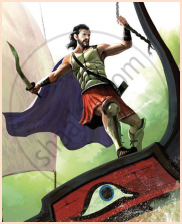
The poem ‘Ulysses’ is a dramatic monologue that contains 70 lines of blank verse. Ulysses, the King of Ithaca, gathers his men together to prepare for the journey and exhorts them not to waste their time left on earth. Ulysses has grown old, having experienced many adventures at the battle of Troy and in the seas. After returning to Ithaca, he desires to embark upon his next voyage. His inquisitive spirit is always looking forward to more and more of such adventures.
Advertisements
उत्तर
The poem can be divided into three parts
- the thirst for adventure, which does not allow Ulysses to remain in his kingdom as a mere ruler;
- Ulysses handing over the responsibility to his son Telemachus, with total confidence in his abilities;
- Ulysses’ clarion calls to his sailors, urging them to venture into unknown lands.
APPEARS IN
संबंधित प्रश्न
Why did the narrator feel helpless?
Read the given line and answer the question that follow in a line or two.
All through the summer at ease we lay,
And daily from the turret wall
We watched the mowers in the hay
- Who does ‘we’ refer to?
- How did the soldiers spend the summer days?
- What could they watch from the turret wall?
Read the given line and answer the question that follow in a line or two.
A foothold there, no clever trick
Could take us dead or quick,
Only a bird could have got in.
- What was challenging?
- Which aspect of the castle’s strength is conveyed by the above line?
They seemed no threat to us at all.
Read the poem and complete the table with suitable rhyming words.
All through that summer at ease we lay,
And daily from the turret wall
We watched the mowers in the hay
And the enemy half a mile away
They seemed no threat to us at all.
For what, we thought, had we to fear
With our arms and provender, load on load,
Our towering battlements, tier on tier,
And friendly allies drawing near
On every leafy summer road.
Our gates were strong, our walls were thick,
So smooth and high, no man could win
A foothold there, no clever trick
Could take us dead or quick,
Only a bird could have got in.
What could they offer us for bait?
Our captain was brave and we were true…
There was a little private gate,
A little wicked wicket gate.
The wizened warder let them through.
Oh then our maze of tunneled stone
Grew thin and treacherous as air.
The cause was lost without a groan,
The famous citadel overthrown,
And all its secret galleries bare.
How can this shameful tale be told?
I will maintain until my death
We could do nothing, being sold:
Our only enemy was gold,
And we had no arms to fight it with.
| lay | hay |
Underline the alliterated word in the following line.
With our arms and provender, load on load.
Underline the alliterated word in the following line.
A little wicked wicket gate.
Identify the figure of speech used in the following line.
How can this shameful tale be told?
What is the creeper compared to?
How does the creeper appear on the tree?
Does nature communicate with human beings?
Explain the following line with reference to the context.
It is the tree’s lament, an eerie speech,…
Identify the figure of speech used in each of the extract given below and write down the answer in the space given below.
“ LIKE a huge Python, winding round and round
The rugged trunk indented deep with scars”,
Fill in the blanks using the words given in the box to complete the summary of the poem.
Shakespeare considers the whole world a stage where men and women are only (1) ______. They (2)______the stage when they are born and exit when they die. Every man, during his life time, plays seven roles based on age. In the first act, as an infant, he is wholly (3) ______on the mother or a nurse. Later, emerging as a school child, he slings his bag over his shoulder and creeps most (4)______ to school. His next act is that of a lover, busy (5) ______ballads for his beloved and yearns for her (6) ______. In the fourth stage, he is aggressive and ambitious and seeks (7) ______in all that he does. He (8) ______solemnly to guard his country and becomes a soldier. As he grows older, with (9) ______and wisdom, he becomes a fair judge. During this stage, he is firm and (10) ______. In the sixth act, he is seen with loose pantaloons and spectacles. His manly voice changes into a childish (11) ______. The last scene of all is his second childhood. Slowly, he loses his (12) ______of sight, hearing, smell and taste and exits from the roles of his life.
| attention | treble | reluctantly |
| actors | maturity | reputation |
| serious | faculties | composing |
| enter | promises | dependent |
How does a man play a lover’s role?
Bring out the features of the fourth stage of a man as described by the poet.
When does a man become a judge? How?
Complete the table based on your understanding of the poem.
| Stage | Characteristic |
| crying | |
| judge | |
| soldier | |
| unhappy | |
| second childhood | |
| whining | |
| old man |
‘Ulysses is not happy to perform his duties as a king.’ Why?
Identify the figure of speech employed in the following line.
Thro’ scudding drifts the rainy Hyades Vext the dim sea...
What is Ulysses’ clarion call to his sailors? How does he inspire them?
Fill in the blanks choosing the words from the box given and complete the summary of the poem.
Lines 1-25
The poet Carl Sandburg gives a vivid description of a father’s worldly (1)______ in directing a son who is at the threshold of his (2) ______.
Here the father motivates his son to be like a hard(3) ______and withstand life’s (4)______ and sudden betrayals. (5)______is like a fertile soil. We can make our life fruitful if we are gentle, and take life as it comes. At times(6)______ overtakes harshness. The growth of a (7)______can split a rock. One should have a (8) ______and strong will to achieve. Greed for(9)______has left men dead before they really die. Good men also have fallen prey in quest for (10) ______money. Time for (11)______is not a waste. When you seek knowledge never feel ashamed to be called a(12)______for not knowing, at the same time learn from your (13) ______and never (14)______it.
| deep desire | manhood | gentleness | mistakes | easy |
| leisure | fool | life | money | repeat |
| tender-flower | rock | challenges | wisdom |
Lines 26-44
Do (15)______often, and do not hesitate to accept your shortcomings, avoid(16) ______to protect self against other people. Solitude helps to be (17)______and(18) ______ are taken in silent rooms. Instead of being one among many, be (19)______, if that is your nature. The son may need lazy days to find his (20)______abilities, to seek what he is born for. He will then know how free imaginations bring (21)______to the world, which (22)______ change. During such resentment, let him know that it is time for him to be on his own, and (23)______to achieve like Shakespeare, the Wright brothers, Pasteur, Pavlov, and Michael Faraday.
| changes | introspect | inherent | work | resents |
| white lies | creative | final decisions | different |
What has twisted good men into thwarted worms?
Read the line given below and answer the question that follow.
Tell him time as a stuff can be wasted.
Tell him to be a fool every so often
- Why does the poet suggest that time can be wasted?
- Identify the figure of speech in the above line.
Read the line given below and answer the question that follow.
..........Free imaginations
Bringing changes into a world resenting change.
- How does free imagination help the world?
- Identify the figure of speech.
Explain the following line with reference to the context.
Brutes have been gentled where lashes failed.
Where was Napoleon standing on the day of attack on the city of Ratisbon?
Explain the following line with reference to the context.
Then off there flung in smiling joy, And held himself erect
Explain the following line with reference to the context.
To see your flag-bird flap his vans Where I, to heart’s desire, Perched him!’
