Advertisements
Advertisements
प्रश्न
Introduction
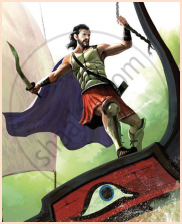
The poem ‘Ulysses’ is a dramatic monologue that contains 70 lines of blank verse. Ulysses, the King of Ithaca, gathers his men together to prepare for the journey and exhorts them not to waste their time left on earth. Ulysses has grown old, having experienced many adventures at the battle of Troy and in the seas. After returning to Ithaca, he desires to embark upon his next voyage. His inquisitive spirit is always looking forward to more and more of such adventures.
Advertisements
उत्तर
The poem can be divided into three parts
- the thirst for adventure, which does not allow Ulysses to remain in his kingdom as a mere ruler;
- Ulysses handing over the responsibility to his son Telemachus, with total confidence in his abilities;
- Ulysses’ clarion calls to his sailors, urging them to venture into unknown lands.
APPEARS IN
संबंधित प्रश्न
Who had let the enemies in?
What was the ‘shameful act’?
Read the given line and answer the question that follow in a line or two.
Our gates were strong, our walls were thick,
So smooth and high, no man could win.
- How safe was the castle?
- What was the firm belief of the soldiers?
They seemed no threat to us at all.
Underline the alliterated word in the following line.
With our arms and provender, load on load.
Underline the alliterated word in the following line.
A little wicked wicket gate.
Can you call ‘The Castle’ an allegorical poem? Discuss.
What is the creeper compared to?
How does the creeper appear on the tree?
Describe the garden during the night.
Why is the casuarina tree dear to poet’s heart?
Read the line given below and answer the question that follow.
A creeper climbs, in whose embraces bound No other tree could live.
- Which tree is referred to in the above lines?
- How does the tree survive the tight hold of the creeper?
- Why does Toru Dutt use the expression ‘a creeper climbs’?
Explain the following line with reference to the context.
It is the tree’s lament, an eerie speech,…
Discuss with your partner the different stages in the growth of man from a new born to an adult

Fill in the blanks using the words given in the box to complete the summary of the poem.
Shakespeare considers the whole world a stage where men and women are only (1) ______. They (2)______the stage when they are born and exit when they die. Every man, during his life time, plays seven roles based on age. In the first act, as an infant, he is wholly (3) ______on the mother or a nurse. Later, emerging as a school child, he slings his bag over his shoulder and creeps most (4)______ to school. His next act is that of a lover, busy (5) ______ballads for his beloved and yearns for her (6) ______. In the fourth stage, he is aggressive and ambitious and seeks (7) ______in all that he does. He (8) ______solemnly to guard his country and becomes a soldier. As he grows older, with (9) ______and wisdom, he becomes a fair judge. During this stage, he is firm and (10) ______. In the sixth act, he is seen with loose pantaloons and spectacles. His manly voice changes into a childish (11) ______. The last scene of all is his second childhood. Slowly, he loses his (12) ______of sight, hearing, smell and taste and exits from the roles of his life.
| attention | treble | reluctantly |
| actors | maturity | reputation |
| serious | faculties | composing |
| enter | promises | dependent |
What is the world compared to?
Explain the following line briefly with reference to the context.
“Jealous in honour, sudden and quick in quarrel,
Seeking the bubble reputation”.“They have their exits and their entrances;
Why did Ulysses want to hand over the kingdom to his son?
Read the set of line from the poem and answer the question that follow.
This is my son, mine own Telemachus,
To whom I leave the sceptre and the isle Well-loved of me,
- Who does Ulysses entrust his kingdom to, in his absence?
- Bring out the significance of the ‘sceptre’.
Read the set of line from the poem and answer the question that follow.
Death closes all: but something ere the end,
Some work of noble note, may yet be done,
Not unbecoming men that strove with Gods.
- The above lines convey the undying spirit of Ulysses. Explain.
- Pick out the words in alliteration in the above lines.
Explain with reference to the context the following line.
....you and I are old;
Old age hath yet his honour and his toil;
List the roles and responsibilities Ulysses assigns to his son Telemachus, while he is away.
What is Ulysses’ clarion call to his sailors? How does he inspire them?
What happened to the people who wanted too much money?
Why does the poet advise his son to have lazy days?
Read the line given below and answer the question that follow.
..........Free imaginations
Bringing changes into a world resenting change.
- How does free imagination help the world?
- Identify the figure of speech.
What does the phrase ‘full galloping’ suggest?
Read the line given below and answer the question that follow.
A film the mother eagles eye When her bruised eaglet breathes
- Who is compared to the mother eagle in the above lines?
- Explain the comparison.
Explain the following line with reference to the context.
To see your flag-bird flap his vans Where I, to heart’s desire, Perched him!’
The young soldier matched his emperor in courage and patriotism. Elucidate your answer.
