Advertisements
Advertisements
प्रश्न
Explain the following line with reference to the context.
To see your flag-bird flap his vans Where I, to heart’s desire, Perched him!’
Advertisements
उत्तर
Reference:
These lines are taken from Poem – “Incident of the French Camp”, Poet – “Robert Browning”.
Context:
The poet is describing the way in which the young soldier informed Napoleon of their success.
Explanation:
Due to their victory, the soldier felt a special kind of joy and pride in the fact that he, with his own hands, had flown the French flag over Ratisbon. The flag had the figure of a bird on it when the flag fluttered in the air, it seemed as the bird was flapping its wings.
APPEARS IN
संबंधित प्रश्न
Have you ever visited a fort or a castle?
Where were the enemies?
Who was the real enemy?
Bring out the contrasting picture of the castle as depicted in stanzas 3 and 5.
Our only enemy was gold
Underline the alliterated word in the following line.
With our arms and provender, load on load.
Underline the alliterated word in the following line.
A little wicked wicket gate.
Can you call ‘The Castle’ an allegorical poem? Discuss.
You visit your school after several years. As you cross the banyan tree at the entrance, cheerful memories fi ll your mind. Fill the bubbles with your memories.

The casuarina tree will be remembered forever. Why?
Read the line given below and answer the question that follow.
A creeper climbs, in whose embraces bound No other tree could live.
- Which tree is referred to in the above lines?
- How does the tree survive the tight hold of the creeper?
- Why does Toru Dutt use the expression ‘a creeper climbs’?
Identify the figure of speech used in each of the extract given below and write down the answer in the space given below.
“ A creeper climbs, in whose embraces bound
No other tree could live. But gallantly
The giant wears the scarf, and flowers are hung......”
Identify the figure of speech used in each of the extract given below and write down the answer in the space given below.
“ What is that dirge-like murmur that I hear Like the sea breaking on a shingle -beach?
Describe the reminiscences of the poet, when she sees the casuarina tree.
What is the world compared to?
Pick out the word in ‘alliteration’ in the following line.
“and all the men and women merely players”
Introduction
The poem ‘Ulysses’ is a dramatic monologue that contains 70 lines of blank verse. Ulysses, the King of Ithaca, gathers his men together to prepare for the journey and exhorts them not to waste their time left on earth. Ulysses has grown old, having experienced many adventures at the battle of Troy and in the seas. After returning to Ithaca, he desires to embark upon his next voyage. His inquisitive spirit is always looking forward to more and more of such adventures.
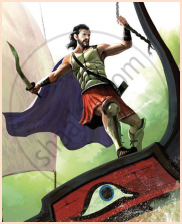
Complete the summary of the poem, choosing words from the list given below. Lines 44 to 70
Ulysses beckons his sailors to (1) ______at the port where the ship is ready to sail. His companions who have faced both (2) ______and sunshine with a smile, are united by their undying spirit of adventure. Though death would end everything, Ulysses urges his companions to join him and sail beyond the sunset and seek a newer (3) ______, regardless of consequences. These brave hearts who had once moved (4) ______ and earth, may have grown old and weak physically but their spirit is young and (5) ______. His call is an inspiration for all those who seek true knowledge and strive to lead (6) ______ lives.
| world, thunder, meaningful, gather, undaunted, heaven |
Pick out the lines which convey that his quest for travel is unending.
What could be the possible outcomes of their travel?
Read the set of line from the poem and answer the question that follow.
This is my son, mine own Telemachus,
To whom I leave the sceptre and the isle Well-loved of me,
- Who does Ulysses entrust his kingdom to, in his absence?
- Bring out the significance of the ‘sceptre’.
Read the set of line from the poem and answer the question that follow.
That ever with a frolic welcome took
The thunder and the sunshine, and opposed
- What do ‘thunder’ and ‘sunshine’ refer to?
- What do we infer about the attitude of the sailors?
Explain with reference to the context the following line.
He works his work, I mine.
Explain with reference to the context the following line.
To strive, to seek, to find, and not to yield.
Read the line given below and answer the question that follow.
..........Free imaginations
Bringing changes into a world resenting change.
- How does free imagination help the world?
- Identify the figure of speech.
Where was Napoleon standing on the day of attack on the city of Ratisbon?
Describe the posture of Napoleon.
Explain the following line with reference to the context.
‘I’m killed, Sire!’ And, his Chief beside, Smiling, the boy fell dead.
