Advertisements
Advertisements
प्रश्न
Identify the figure of speech used in the following line.
Oh then our maze of tunneled stone
Advertisements
उत्तर
Metaphor
APPEARS IN
संबंधित प्रश्न
Where were the enemies?
Who had let the enemies in?
Underline the alliterated word in the following line.
With our arms and provender, load on load.
Identify the figure of speech used in the following line.
A little wicked wicket gate.
Fill in the blanks choosing the words from the box given and complete the summary of the poem.
The casuarina tree is tall and strong, with a creeper winding around it like a (1) ______. The tree stands like a (2) ______with a colourful scarf of flowers. Birds surround the garden and the sweet song of the birds is heard. The poet is delighted to see the casuarina tree through her (3) ______. She sees a grey monkey sitting like a (4) ______on top of the tree, the cows grazing, and the water lilies (5) ______in the pond. The poet feels that the tree is dear to her not for its (6) ______appearance but for the (7) ______memories of her happy childhood that it brings to her. She strongly believes that (8) ______communicates with human beings. The poet could communicate with the tree even when she was in a far-off land as she could hear the tree (9) ______her absence. The poet (10) ______the tree’s memory to her loved ones, who are not alive. She immortalizes the tree through her poem like the poet Wordsworth who (11) ______the yew tree of Borrowdale in verse. She expresses her wish that the tree should be remembered out of love and not just because it cannot be (12) ______.
| python | statue | nature | casement |
| nostalgic | lamenting | impressive | forgotten |
| giant | consecrates | springing | sanctified |
How does the creeper appear on the tree?
Read the line given below and answer the question that follow.
A creeper climbs, in whose embraces bound No other tree could live.
- Which tree is referred to in the above lines?
- How does the tree survive the tight hold of the creeper?
- Why does Toru Dutt use the expression ‘a creeper climbs’?
Why is the last stage called second childhood?
Pick out the word in ‘alliteration’ in the following line.
“Jealous in honour, sudden and quick in quarrel.”
Read the given line and answer the question that follow.
And then the justice,
In fair round belly with good capon lin'd,
With eyes severe and beard of formal cut,
Full of wise saws and modern instances;
- Whom does justice refer to?
- Describe his appearance.
- How does he behave with the people around him?
- What does he do to show his wisdom?
Describe the various stages of a man’s life picturised in the poem “All the World’s a stage."
Introduction
The poem ‘Ulysses’ is a dramatic monologue that contains 70 lines of blank verse. Ulysses, the King of Ithaca, gathers his men together to prepare for the journey and exhorts them not to waste their time left on earth. Ulysses has grown old, having experienced many adventures at the battle of Troy and in the seas. After returning to Ithaca, he desires to embark upon his next voyage. His inquisitive spirit is always looking forward to more and more of such adventures.
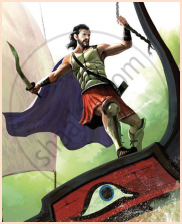
Complete the summary of the poem, choosing words from the list given below. Lines 33 to 42
Ulysses desires to hand over his (1) ______to his son Telemachus, who would fulfil his duties towards his subjects with care and (2) ______. Telemachus possesses patience and has the will to civilise the citizens of Ithaca in a (3) ______way. Ulysses is happy that his son would do his work blamelessly and he would pursue his (4) ______for travel and knowledge.
| prudence, kingdom, quest, tender |
What does he think of the people of his kingdom?
What has Ulysses gained from his travel experiences?
What does Ulysses yearn for?
Who does the speaker address in the second part?
Why did Ulysses want to hand over the kingdom to his son?
Identify the figure of speech employed in the following line.
Thro’ scudding drifts the rainy Hyades Vext the dim sea...
Explain with reference to the context the following line.
I cannot rest from travel: I will drink Life to the lees:
Explain with reference to the context the following line.
How dull it is to pause, to make an end,
To rust unburnished, not to shine in use!
Explain with reference to the context the following line.
He works his work, I mine.
Where are the final decisions taken?
Read the line given below and answer the question that follow.
“Life is hard; be steel; be a rock.”
- How should one face life?
- Identify the figure of speech in the above line.
Read the line given below and answer the question that follow.
Tell him to be a fool ever so often
and to have no shame over having been a fool
yet learning something out of every folly
hoping to repeat none of the cheap follies
- Is it a shame to be a fool at times?
- What does one learn from every folly?
Read the line given below and answer the question that follow.
..........Free imaginations
Bringing changes into a world resenting change.
- How does free imagination help the world?
- Identify the figure of speech.
Pick out the alliterated words from the poem and write.
And this might stand him for the storms
Explain how the poet guides his son who is at the threshold of manhood, to face the challenges of life.
Why did the rider keep his lips compressed?
