Advertisements
Advertisements
प्रश्न
I will maintain until my death
Advertisements
उत्तर
- Reference:
This line is taken from the Poem – “The Castle”, Poet – “Edwin Muir”. - Context:
Here the poet talks about the ‘shameful act’. - Explanation:
The narrator decided not to disclose this shameful story (soldiers got failure because of the greedy disloyal warder) to anyone. This will be maintained until his death.
APPEARS IN
संबंधित प्रश्न
What thoughts come to your mind when you think about a castle? Add your ideas to the list
moat, huge buildings, soldiers, weapons ______,______.
How did the enemies enter the castle?
Read the given line and answer the question that follow in a line or two.
Our gates were strong, our walls were thick,
So smooth and high, no man could win.
- How safe was the castle?
- What was the firm belief of the soldiers?
Read the given line and answer the question that follow in a line or two.
A foothold there, no clever trick
Could take us dead or quick,
Only a bird could have got in.
- What was challenging?
- Which aspect of the castle’s strength is conveyed by the above line?
Read the given line and answer the question that follow in a line or two.
We could do nothing, being sold.
- Why couldn’t they do anything?
- Why did they feel helpless?
They seemed no threat to us at all.
Fill in the blanks choosing the words from the box given and complete the summary of the poem.
The casuarina tree is tall and strong, with a creeper winding around it like a (1) ______. The tree stands like a (2) ______with a colourful scarf of flowers. Birds surround the garden and the sweet song of the birds is heard. The poet is delighted to see the casuarina tree through her (3) ______. She sees a grey monkey sitting like a (4) ______on top of the tree, the cows grazing, and the water lilies (5) ______in the pond. The poet feels that the tree is dear to her not for its (6) ______appearance but for the (7) ______memories of her happy childhood that it brings to her. She strongly believes that (8) ______communicates with human beings. The poet could communicate with the tree even when she was in a far-off land as she could hear the tree (9) ______her absence. The poet (10) ______the tree’s memory to her loved ones, who are not alive. She immortalizes the tree through her poem like the poet Wordsworth who (11) ______the yew tree of Borrowdale in verse. She expresses her wish that the tree should be remembered out of love and not just because it cannot be (12) ______.
| python | statue | nature | casement |
| nostalgic | lamenting | impressive | forgotten |
| giant | consecrates | springing | sanctified |
Read the line given below and answer the question that follow.
The giant wears the scarf, and flowers are hung
In crimson clusters all the bough among!
- Who is the giant here?
- Why is the scarf colourful?
Explain the following line with reference to the context.
It is the tree’s lament, an eerie speech,…
Fill in the blanks using the words given in the box to complete the summary of the poem.
Shakespeare considers the whole world a stage where men and women are only (1) ______. They (2)______the stage when they are born and exit when they die. Every man, during his life time, plays seven roles based on age. In the first act, as an infant, he is wholly (3) ______on the mother or a nurse. Later, emerging as a school child, he slings his bag over his shoulder and creeps most (4)______ to school. His next act is that of a lover, busy (5) ______ballads for his beloved and yearns for her (6) ______. In the fourth stage, he is aggressive and ambitious and seeks (7) ______in all that he does. He (8) ______solemnly to guard his country and becomes a soldier. As he grows older, with (9) ______and wisdom, he becomes a fair judge. During this stage, he is firm and (10) ______. In the sixth act, he is seen with loose pantaloons and spectacles. His manly voice changes into a childish (11) ______. The last scene of all is his second childhood. Slowly, he loses his (12) ______of sight, hearing, smell and taste and exits from the roles of his life.
| attention | treble | reluctantly |
| actors | maturity | reputation |
| serious | faculties | composing |
| enter | promises | dependent |
What is the world compared to?
Which stage of man’s life is associated with the ‘shrunk shank’?
Describe the various stages of a man’s life picturised in the poem “All the World’s a stage."
Introduction
The poem ‘Ulysses’ is a dramatic monologue that contains 70 lines of blank verse. Ulysses, the King of Ithaca, gathers his men together to prepare for the journey and exhorts them not to waste their time left on earth. Ulysses has grown old, having experienced many adventures at the battle of Troy and in the seas. After returning to Ithaca, he desires to embark upon his next voyage. His inquisitive spirit is always looking forward to more and more of such adventures.
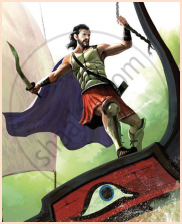
Who does the speaker address in the second part?
‘He works his work, I mine’ – How is the work distinguished?
Identify the figure of speech employed in the following line.
To follow knowledge like a sinking star.
Read the set of line from the poem and answer the question that follow.
Yet all experience is an arch wherethrough
Gleams that untravelled world, whose margin fades
For ever and for ever when I move
- What is experience compared to?
- How do the lines convey that the experience is endless?
Explain with reference to the context the following line.
How dull it is to pause, to make an end,
To rust unburnished, not to shine in use!
Explain with reference to the context the following line.
It may be we shall touch the Happy Isles,
And see the great Achilles, whom we knew.
‘A tough will counts.’ Explain.
What happened to the people who wanted too much money?
What are the poet’s thoughts on ‘being different’?
The poet says
‘Without rich wanting nothing arrives’ but he condemns ‘the quest of lucre beyond a few easy needs.’ Analyse the difference and write.
Explain the following line with reference to the context.
He will be lonely enough
to have time for the work
Explain the following line with reference to the context.
Brutes have been gentled where lashes failed.
Have you played chess or watched the game carefully?
Now identify the chess pieces and complete the table below. Discuss the role of each piece in the game.
 |
|
 |
|
 |
|
 |
|
 |
|
 |
How did the young soldier face his end?
