Advertisements
Advertisements
प्रश्न
Explain with reference to the context the following line.
....you and I are old;
Old age hath yet his honour and his toil;
Advertisements
उत्तर
- Reference: These lines are from the poem ‘Ulysses” written by Alfred Tennyson.
- Context and Explanation: Poet, in this part of the monologue describes the address made by Ulysses to his compatriots who were with him during “thunders and sunshine”. He admits the fact that they are growing old. But he does not want to retire like ordinary mortals. He accepts gratefully the honor befitting old age as a result of varied cultural experiences. Yet, he does not want old people to bow out of the field of action. He sincerely believes there is more work to be done, lands to be explored and newer knowledge to be acquired in old age before death.
APPEARS IN
संबंधित प्रश्न
Fill in the following empty boxes.
| Name | Location |
| Fort St. George | Chennai |
| Gingee Fort | ______ |
| Golconda Fort | ______ |
| Red Fort | ______ |
Where were the enemies?
Why does the narrator say that the enemy was no threat at all?
What was the ‘shameful act’?
Bring out the contrasting picture of the castle as depicted in stanzas 3 and 5.
Read the given line and answer the question that follow in a line or two.
Our gates were strong, our walls were thick,
So smooth and high, no man could win.
- How safe was the castle?
- What was the firm belief of the soldiers?
Underline the alliterated word in the following line.
With our arms and provender, load on load.
Identify the figure of speech used in the following line.
Oh then our maze of tunneled stone
Identify the figure of speech used in the following line.
Grew thin and treacherous as air.
To whom does Toru Dutt want to consecrate the tree’s memory?
Describe the second stage of life as depicted by Shakespeare.
Complete the table based on your understanding of the poem.
| Stage | Characteristic |
| crying | |
| judge | |
| soldier | |
| unhappy | |
| second childhood | |
| whining | |
| old man |
Describe the various stages of a man’s life picturised in the poem “All the World’s a stage."
Introduction
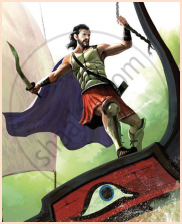
The poem ‘Ulysses’ is a dramatic monologue that contains 70 lines of blank verse. Ulysses, the King of Ithaca, gathers his men together to prepare for the journey and exhorts them not to waste their time left on earth. Ulysses has grown old, having experienced many adventures at the battle of Troy and in the seas. After returning to Ithaca, he desires to embark upon his next voyage. His inquisitive spirit is always looking forward to more and more of such adventures.
Complete the summary of the poem, choosing words from the list given below. Lines 33 to 42
Ulysses desires to hand over his (1) ______to his son Telemachus, who would fulfil his duties towards his subjects with care and (2) ______. Telemachus possesses patience and has the will to civilise the citizens of Ithaca in a (3) ______way. Ulysses is happy that his son would do his work blamelessly and he would pursue his (4) ______for travel and knowledge.
| prudence, kingdom, quest, tender |
What could be the possible outcomes of their travel?
Here are a few poetic device used in the poem.
Antithesis- It is a literary device that emphasises the idea of contrast.
Read the line given below and answer the question that follow.
“Life is hard; be steel; be a rock.”
- How should one face life?
- Identify the figure of speech in the above line.
Read the line given below and answer the question that follow.
Tell him time as a stuff can be wasted.
Tell him to be a fool every so often
- Why does the poet suggest that time can be wasted?
- Identify the figure of speech in the above line.
Read the line given below and answer the question that follow.
Tell him to be a fool ever so often
and to have no shame over having been a fool
yet learning something out of every folly
hoping to repeat none of the cheap follies
- Is it a shame to be a fool at times?
- What does one learn from every folly?
Explain the following line with reference to the context.
and guide him among sudden betrayals
and tighten him for slack moments.
Explain the following line with reference to the context.
Brutes have been gentled where lashes failed.
How according to the poet is it possible for his son to bring changes into a world that resents change?
Who do you think is the narrator of the poem?
Where did the rider plant the French flag after Ratisbon was captured?
Explain the following line with reference to the context.
‘I’m killed, Sire!’ And, his Chief beside, Smiling, the boy fell dead.
Explain the following line with reference to the context.
To see your flag-bird flap his vans Where I, to heart’s desire, Perched him!’
What is the role of the young soldier in the victory of the French at Ratisbon?
