Advertisements
Advertisements
प्रश्न
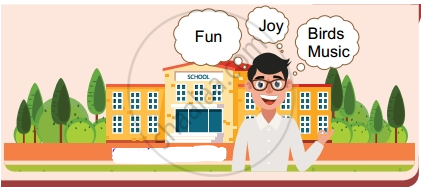
You visit your school after several years. As you cross the banyan tree at the entrance, cheerful memories fi ll your mind. Fill the bubbles with your memories.

Advertisements
उत्तर
APPEARS IN
संबंधित प्रश्न
What thoughts come to your mind when you think about a castle? Add your ideas to the list
moat, huge buildings, soldiers, weapons ______,______.
Who is the narrator in the poem?
Why does the narrator say that the enemy was no threat at all?
What was the ‘shameful act’?
Why didn’t the narrator want to tell the tale to anybody?
Who was the real enemy?
Read the given line and answer the question that follow in a line or two.
A foothold there, no clever trick
Could take us dead or quick,
Only a bird could have got in.
- What was challenging?
- Which aspect of the castle’s strength is conveyed by the above line?
Read the given line and answer the question that follow in a line or two.
We could do nothing, being sold.
- Why couldn’t they do anything?
- Why did they feel helpless?
Underline the alliterated word in the following line.
A little wicked wicket gate.
Underline the alliterated word in the following line.
The wizened warder let them through.
Identify the figure of speech used in the following line.
A little wicked wicket gate.
Name the bird that sings in the poet’s garden.
Describe the reminiscences of the poet, when she sees the casuarina tree.
Discuss with your partner the different stages in the growth of man from a new born to an adult

Fill in the blanks using the words given in the box to complete the summary of the poem.
Shakespeare considers the whole world a stage where men and women are only (1) ______. They (2)______the stage when they are born and exit when they die. Every man, during his life time, plays seven roles based on age. In the first act, as an infant, he is wholly (3) ______on the mother or a nurse. Later, emerging as a school child, he slings his bag over his shoulder and creeps most (4)______ to school. His next act is that of a lover, busy (5) ______ballads for his beloved and yearns for her (6) ______. In the fourth stage, he is aggressive and ambitious and seeks (7) ______in all that he does. He (8) ______solemnly to guard his country and becomes a soldier. As he grows older, with (9) ______and wisdom, he becomes a fair judge. During this stage, he is firm and (10) ______. In the sixth act, he is seen with loose pantaloons and spectacles. His manly voice changes into a childish (11) ______. The last scene of all is his second childhood. Slowly, he loses his (12) ______of sight, hearing, smell and taste and exits from the roles of his life.
| attention | treble | reluctantly |
| actors | maturity | reputation |
| serious | faculties | composing |
| enter | promises | dependent |
How does a man play a lover’s role?
Which stage of man’s life is associated with the ‘shrunk shank’?
Explain the following line briefly with reference to the context.
“They have their exits and their entrances;
And one man in his time plays many parts,”
Read the given line and answer the question that follow.
Then the whining school-boy, with his satchel
And shining morning face, creeping like snail
Unwillingly to school.
- Which stage of life is being referred to here by the poet?
- What are the characteristics of this stage?
- How does the boy go to school?
- Which figure of speech has been employed in the second line?
What has Ulysses gained from his travel experiences?
Identify the figure of speech employed in the following line.
For always roaming with a hungry heart
Explain with reference to the context the following line.
It may be we shall touch the Happy Isles,
And see the great Achilles, whom we knew.
What makes Ulysses seek newer adventures?
What has twisted good men into thwarted worms?
Read the line given below and answer the question that follow.
Tell him solitude is creative if he is strong and the final decisions are made in silent rooms.
- Can being in solitude help a strong human being? How?
- Identify the figure of speech in the above line.
Read the line given below and answer the question that follow.
Tell him to be a fool ever so often
and to have no shame over having been a fool
yet learning something out of every folly
hoping to repeat none of the cheap follies
- Is it a shame to be a fool at times?
- What does one learn from every folly?
Explain the following line with reference to the context.
Brutes have been gentled where lashes failed.
Have you played chess or watched the game carefully?
Now identify the chess pieces and complete the table below. Discuss the role of each piece in the game.
 |
|
 |
|
 |
|
 |
|
 |
|
 |
Why was the rider in a hurry?
What was Napoleon’s reaction on hearing the news of victory?
