Advertisements
Advertisements
Question
What could be the possible outcomes of their travel?
Advertisements
Solution
The sailors and Ulysses may be washed down by the gulfs or they could touch Greek paradise and meet their hero Achilles. They may die happily braving the elements of nature.
APPEARS IN
RELATED QUESTIONS
Why does the narrator say that the enemy was no threat at all?
Did the soldiers fight with the enemies face to face?
Read the poem again and complete the summary using the words given in box.
Stanzas 1–3
‘The Castle’ by Edwin Muir is a moving poem on the (1)______ of a well guarded (2)______ The soldiers of the castle were totally stress-free and relaxed. They were (3)______ of their castle’s physical strength. Through the turrets they were able to watch the mowers and no enemy was found up to the distance of (4)______ and so they seemed no threat to the castle. They had (5)______ of weapons to protect them and a large quantity of (6)______ in stock to take care of the well-being of the soldiers inside the castle. The soldiers stood one above the other on the towering battlements (7)______ to shoot the enemy at sight. They believed that the castle was absolutely safe because their captain was (8)______ and the soldiers were loyal.
| half-a-mile | watching |
| castle | brave |
| ration | capture |
| plenty | confident |
Stanzas 4–6
Even by a trick no one but the birds could enter. The enemy could not use a (9)______ for their entry inside the castle. But there was a wicket gate guarded by a (10) ______ He (11)______ in the enemies inside the famous citadel that had been known for its secret gallery and intricate path. The strong castle became(12)______ and thin because of the greedy disloyal warder. The (13)______ was captured by the enemies for (14)______ The narrator (15)______ over the (16)______ of the useless warder and also decided not to disclose this (17)______ story to anyone. He was (18)______ and wondered how he would keep this truth to himself. He regretted not finding any (19)______ to fight with the (20)______ called ‘gold’.
| lamented | shameful |
| wicked guard | bait |
| let | gold |
| weapon | citadel |
| weak | disloyalty |
| helpless | enemy |
Bring out the contrasting picture of the castle as depicted in stanzas 3 and 5.
Underline the alliterated word in the following line.
With our arms and provender, load on load.
Identify the figure of speech used in the following line.
A little wicked wicket gate.
Fill in the blanks choosing the words from the box given and complete the summary of the poem.
The casuarina tree is tall and strong, with a creeper winding around it like a (1) ______. The tree stands like a (2) ______with a colourful scarf of flowers. Birds surround the garden and the sweet song of the birds is heard. The poet is delighted to see the casuarina tree through her (3) ______. She sees a grey monkey sitting like a (4) ______on top of the tree, the cows grazing, and the water lilies (5) ______in the pond. The poet feels that the tree is dear to her not for its (6) ______appearance but for the (7) ______memories of her happy childhood that it brings to her. She strongly believes that (8) ______communicates with human beings. The poet could communicate with the tree even when she was in a far-off land as she could hear the tree (9) ______her absence. The poet (10) ______the tree’s memory to her loved ones, who are not alive. She immortalizes the tree through her poem like the poet Wordsworth who (11) ______the yew tree of Borrowdale in verse. She expresses her wish that the tree should be remembered out of love and not just because it cannot be (12) ______.
| python | statue | nature | casement |
| nostalgic | lamenting | impressive | forgotten |
| giant | consecrates | springing | sanctified |
How does the poet spend her winter?
Name the bird that sings in the poet’s garden.
The casuarina tree will be remembered forever. Why?
“And they have their exits and their entrances” - What do the words ‘exits’ and ‘entrances’ mean?
What is the first stage of a human’s life?
Bring out the features of the fourth stage of a man as described by the poet.
Explain the following line briefly with reference to the context.
“Jealous in honour, sudden and quick in quarrel,
Seeking the bubble reputation”.“They have their exits and their entrances;
Pick out the word in ‘alliteration’ in the following line.
“And one man in his time plays many parts”
Complete the table based on your understanding of the poem.
| Stage | Characteristic |
| crying | |
| judge | |
| soldier | |
| unhappy | |
| second childhood | |
| whining | |
| old man |
Shakespeare has skilfully brought out the parallels between the life of man and actors on stage. Elaborate this statement with reference to the poem.
Introduction
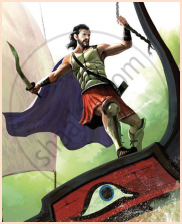
The poem ‘Ulysses’ is a dramatic monologue that contains 70 lines of blank verse. Ulysses, the King of Ithaca, gathers his men together to prepare for the journey and exhorts them not to waste their time left on earth. Ulysses has grown old, having experienced many adventures at the battle of Troy and in the seas. After returning to Ithaca, he desires to embark upon his next voyage. His inquisitive spirit is always looking forward to more and more of such adventures.
Complete the summary of the poem, choosing words from the list given below. Lines 44 to 70
Ulysses beckons his sailors to (1) ______at the port where the ship is ready to sail. His companions who have faced both (2) ______and sunshine with a smile, are united by their undying spirit of adventure. Though death would end everything, Ulysses urges his companions to join him and sail beyond the sunset and seek a newer (3) ______, regardless of consequences. These brave hearts who had once moved (4) ______ and earth, may have grown old and weak physically but their spirit is young and (5) ______. His call is an inspiration for all those who seek true knowledge and strive to lead (6) ______ lives.
| world, thunder, meaningful, gather, undaunted, heaven |
Explain with reference to the context the following line.
The long day wanes: the slow moon climbs:
the deep Moans round with many voices.
Explain with reference to the context the following line.
We are not now that strength which in old days Moved earth and heaven;
Explain with reference to the context the following line.
To strive, to seek, to find, and not to yield.
Where are the final decisions taken?
Explain the following line with reference to the context.
Yet learning something out of every folly
hoping to repeat none of the cheap follies
Who took the city of Ratisbon by storm?
Who came galloping on a horse to Napoleon?
Why was the rider in a hurry?
The young soldier matched his emperor in courage and patriotism. Elucidate your answer.
