Advertisements
Advertisements
Question
Pick out the alliterated words from the poem and write.
And this might stand him for the storms
Advertisements
Solution
The words stand and storms alliterate.
APPEARS IN
RELATED QUESTIONS
Fill in the following empty boxes.
| Name | Location |
| Fort St. George | Chennai |
| Gingee Fort | ______ |
| Golconda Fort | ______ |
| Red Fort | ______ |
Where were the enemies?
Why were the secret galleries bare?
Read the poem again and complete the summary using the words given in box.
Stanzas 1–3
‘The Castle’ by Edwin Muir is a moving poem on the (1)______ of a well guarded (2)______ The soldiers of the castle were totally stress-free and relaxed. They were (3)______ of their castle’s physical strength. Through the turrets they were able to watch the mowers and no enemy was found up to the distance of (4)______ and so they seemed no threat to the castle. They had (5)______ of weapons to protect them and a large quantity of (6)______ in stock to take care of the well-being of the soldiers inside the castle. The soldiers stood one above the other on the towering battlements (7)______ to shoot the enemy at sight. They believed that the castle was absolutely safe because their captain was (8)______ and the soldiers were loyal.
| half-a-mile | watching |
| castle | brave |
| ration | capture |
| plenty | confident |
Stanzas 4–6
Even by a trick no one but the birds could enter. The enemy could not use a (9)______ for their entry inside the castle. But there was a wicket gate guarded by a (10) ______ He (11)______ in the enemies inside the famous citadel that had been known for its secret gallery and intricate path. The strong castle became(12)______ and thin because of the greedy disloyal warder. The (13)______ was captured by the enemies for (14)______ The narrator (15)______ over the (16)______ of the useless warder and also decided not to disclose this (17)______ story to anyone. He was (18)______ and wondered how he would keep this truth to himself. He regretted not finding any (19)______ to fight with the (20)______ called ‘gold’.
| lamented | shameful |
| wicked guard | bait |
| let | gold |
| weapon | citadel |
| weak | disloyalty |
| helpless | enemy |
Bring out the contrasting picture of the castle as depicted in stanzas 3 and 5.
They seemed no threat to us at all.
Identify the figure of speech used in the following line.
Grew thin and treacherous as air.
Can you call ‘The Castle’ an allegorical poem? Discuss.
Name the bird that sings in the poet’s garden.
Read the line given below and answer the question that follow.
The giant wears the scarf, and flowers are hung
In crimson clusters all the bough among!
- Who is the giant here?
- Why is the scarf colourful?
Identify the figure of speech used in each of the extract given below and write down the answer in the space given below.
“A gray baboon sits statue-like alone’’
Describe the second stage of life as depicted by Shakespeare.
Why is the last stage called second childhood?
Read the given line and answer the question that follow.
And then the justice,
In fair round belly with good capon lin'd,
With eyes severe and beard of formal cut,
Full of wise saws and modern instances;
- Whom does justice refer to?
- Describe his appearance.
- How does he behave with the people around him?
- What does he do to show his wisdom?
Describe the various stages of a man’s life picturised in the poem “All the World’s a stage."
Introduction
The poem ‘Ulysses’ is a dramatic monologue that contains 70 lines of blank verse. Ulysses, the King of Ithaca, gathers his men together to prepare for the journey and exhorts them not to waste their time left on earth. Ulysses has grown old, having experienced many adventures at the battle of Troy and in the seas. After returning to Ithaca, he desires to embark upon his next voyage. His inquisitive spirit is always looking forward to more and more of such adventures.
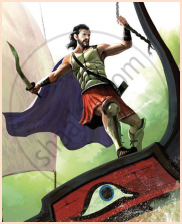
What does he think of the people of his kingdom?
Who does the speaker address in the second part?
Read the set of line from the poem and answer the question that follow.
That ever with a frolic welcome took
The thunder and the sunshine, and opposed
- What do ‘thunder’ and ‘sunshine’ refer to?
- What do we infer about the attitude of the sailors?
Read the set of line from the poem and answer the question that follow.
Death closes all: but something ere the end,
Some work of noble note, may yet be done,
Not unbecoming men that strove with Gods.
- The above lines convey the undying spirit of Ulysses. Explain.
- Pick out the words in alliteration in the above lines.
Explain with reference to the context the following line.
We are not now that strength which in old days Moved earth and heaven;
What has twisted good men into thwarted worms?
Here are a few poetic device used in the poem.
Antithesis- It is a literary device that emphasises the idea of contrast.
Read the line given below and answer the question that follow.
Tell him solitude is creative if he is strong and the final decisions are made in silent rooms.
- Can being in solitude help a strong human being? How?
- Identify the figure of speech in the above line.
Explain the following line with reference to the context.
Brutes have been gentled where lashes failed.
Where did the rider plant the French flag after Ratisbon was captured?
What was Napoleon’s reaction on hearing the news of victory?
Why did Napoleon’s eyes become soft as a mother eagle’s eyes?
Explain the following line with reference to the context.
Then off there flung in smiling joy, And held himself erect
