Advertisements
Advertisements
Question
Explain the following line with reference to the context.
Yet learning something out of every folly
hoping to repeat none of the cheap follies
Advertisements
Solution
- Reference: These lines are from the poem “A Father to his Son” written by Carl August Sandburg.
- Context and Explanation: The poet says these words while hinting at the possibilities of failures in the pursuit of knowledge. People may mock a beginner as a fool. He should not feel ashamed of being called a fool. He must continue the pursuit of knowledge doggedly to achieve success.
APPEARS IN
RELATED QUESTIONS
Who is the narrator in the poem?
Read the given line and answer the question that follow in a line or two.
| Oh then our maze of tunneled stone Grew thin and treacherous as air. The castle was lost without a groan, The famous citadel overthrown, |
- Bring out the contrast in the first two lines.
- What is the rhyme scheme of the given stanza?
Our captain was brave and we were true
Underline the alliterated word in the following line.
With our arms and provender, load on load.
Identify the figure of speech used in the following line.
Oh then our maze of tunneled stone
Name the bird that sings in the poet’s garden.
“And they have their exits and their entrances” - What do the words ‘exits’ and ‘entrances’ mean?
Describe the second stage of life as depicted by Shakespeare.
How does a man play a lover’s role?
Read the poem once again carefully and identify the figure of speech that has been used in each of the following lines from the poem.
“All the world’s a stage,
And all the men and women merely players;
They have their exits and their entrances;
And one man in his time plays many parts,
His acts being seven ages. At first the infant,
Mewling and puking in the nurse’s arms;
Then the whining school-boy, with his satchel
And shining morning face, creeping like snail
Unwillingly to school. And then the lover,
Sighing like furnace, with a woeful ballad
Made to his mistress’ eyebrow. Then a soldier,
Full of strange oaths, and bearded like the pard,
Jealous in honour, sudden and quick in quarrel,
Seeking the bubble reputation
Even in the cannon’s mouth. And then the justice,
In fair round belly with good capon lin’d,
With eyes severe and beard of formal cut,
Full of wise saws and modern instances;
And so he plays his part. The sixth age shifts
Into the lean and slipper’d pantaloon,
With spectacles on nose and pouch on side;
His youthful hose, well sav’d, a world too wide
For his shrunk shank; and his big manly voice,
Turning again toward childish treble, pipes
And whistles in his sound. Last scene of all,
That ends this strange eventful history,
Is second childishness and mere oblivion;
Sans teeth, sans eyes, sans taste, sans everything.”
- “All the world's a stage”
- “And all the men and women merely players”
- “And shining morning face, creeping like snail”
- “Full of strange oaths, and bearded like the pard,”
- “Seeking the bubble reputation”
- “His youthful hose, well sav’d, a world too wide”
- “and his big manly voice, turning again toward childish treble”
Pick out the word in ‘alliteration’ in the following line.
“And one man in his time plays many parts”
Read the given line and answer the question that follow.
Then a soldier,
full of strange oaths, and bearded like the pard,
Jealous in honour, sudden and quick in quarrel,
Seeking the bubble reputation
Even in the cannon's mouth.
- What is the soldier ready to do?
- Explain ‘bubble reputation’.
- What are the distinguishing features of this stage?
Complete the table based on your understanding of the poem.
| Stage | Characteristic |
| crying | |
| judge | |
| soldier | |
| unhappy | |
| second childhood | |
| whining | |
| old man |
Introduction
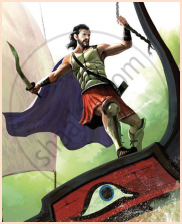
The poem ‘Ulysses’ is a dramatic monologue that contains 70 lines of blank verse. Ulysses, the King of Ithaca, gathers his men together to prepare for the journey and exhorts them not to waste their time left on earth. Ulysses has grown old, having experienced many adventures at the battle of Troy and in the seas. After returning to Ithaca, he desires to embark upon his next voyage. His inquisitive spirit is always looking forward to more and more of such adventures.
Complete the summary of the poem, choosing words from the list given below. Lines 1 to 32
Ulysses is (1) ______to discharge his duties as a (2) ______, as he longs for (3) ______. He is filled with an (4) ______thirst for (5) ______and wishes to live life to the (6) ______. He has travelled far and wide gaining (7) _______ of various places, cultures, men and (8) ______. He recalls with delight his experience at the battle of Troy. Enriched by his (9) ______he longs for more and his quest seems endless. Like metal which would (10) ______if unused, life without adventure is meaningless. According to him living is not merely (11) ______to stay alive. Though old but zestful, Ulysses looks at every hour as a bringer of new things and yearns to follow knowledge even if it is (12)______.
| fullest, unquenchable, unattainable, experience, knowledge, king, matters, rust, adventure, unwilling, travel, breathing |
What could be the possible outcomes of their travel?
Identify the figure of speech employed in the following line.
For always roaming with a hungry heart
Identify the figure of speech employed in the following line.
And drunk delight of battle with my peers;
Read the set of line from the poem and answer the question that follow.
Yet all experience is an arch wherethrough
Gleams that untravelled world, whose margin fades
For ever and for ever when I move
- What is experience compared to?
- How do the lines convey that the experience is endless?
Read the set of line from the poem and answer the question that follow.
Little remains: but every hour is saved
From that eternal silence, something more,
A bringer of new things; and vile it were
- How is every hour important to Ulysses?
- What does the term ‘Little remains’ convey?
Read the set of line from the poem and answer the question that follow.
Death closes all: but something ere the end,
Some work of noble note, may yet be done,
Not unbecoming men that strove with Gods.
- The above lines convey the undying spirit of Ulysses. Explain.
- Pick out the words in alliteration in the above lines.
Explain with reference to the context the following line.
I cannot rest from travel: I will drink Life to the lees:
Explain with reference to the context the following line.
He works his work, I mine.
Where are the final decisions taken?
Explain the following line with reference to the context.
He will be lonely enough
to have time for the work
Describe the posture of Napoleon.
Who came galloping on a horse to Napoleon?
Why did the rider keep his lips compressed?
How did the young soldier face his end?
Read the line given below and answer the question that follow.
‘You’re wounded!’ ‘Nay’, his soldier’s pride Touched to the quick, he said:
- Why did the boy contradict Napoleon’s words?
- Why was his pride touched?
