Advertisements
Advertisements
Question
The perpendicular AD on the base BC of a ∆ABC intersects BC at D so that DB = 3 CD. Prove that `2"AB"^2 = 2"AC"^2 + "BC"^2`
Advertisements
Solution 1
We have
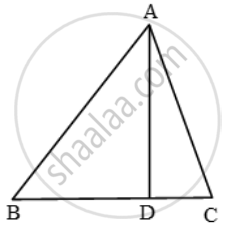
DB = 3CD
BC = BD + DC
The perpendicular AD on the base BC of a ∆ABC intersects BC at D so that DB = 3 CD. Prove that 2AC2 + BC2.
We have,
DB = 3CD
∴ BC = BD + DC
⇒ BC = 3 CD + CD
`⇒ BD = 4 CD ⇒ CD = \frac { 1 }{ 4 } BC`
`∴ CD = \frac { 1 }{ 4 } BC and BD = 3CD = \frac { 1 }{ 4 } BC ….(i)`
Since ∆ABD is a right triangle right-angled at D.
`∴ AB^2 = AD^2 + BD^2 ….(ii)`
Similarly, ∆ACD is a right triangle right angled at D.
`∴ AC^2 = AD^2 + CD^2 ….(iii)`
Subtracting equation (iii) from equation (ii) we get
`AB^2 – AC^2 = BD^2 – CD^2`
`⇒ AB^2 – AC^2 = ( \frac{3}{4}BC)^{2}-( \frac{1}{4}BC)^{2}[`
`⇒ AB^2 – AC^2 = \frac { 9 }{ 16 } BC^2 – \frac { 1 }{ 16 } BC^2`
`⇒ AB^2 – AC^2 = \frac { 1 }{ 2 } BC^2`
`⇒ 2(AB^2 – AC^2 ) = BC^2`
`⇒ 2AB^2 = 2AC^2 + BC^2`
Solution 2
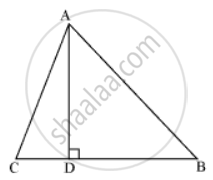
In ΔACD
AC2 = AD2 + DC2
AD2 = AC2 - DC2 ...(1)
In ΔABD
AB2 = AD2 + DB2
AD2 = AB2 - DB2 ...(2)
From equation (1) and (2)
Therefore AC2 - DC2 = AB2 - DB2
since given that 3DC = DB
DC = `"BC"/(4) and "DB" = (3"BC")/(4)`
`"AC"^2 - ("BC"/4)^2 = "AB"^2 - ((3"BC")/4)^2`
`"AC"^2 - "Bc"^2/(16) = "AB"^2 - (9"BC"^2)/(16)`
16AC2 - BC2 = 16AB2 - 9BC2
⇒ 16AB2 - 16AC2 = 8BC2
⇒ 2AB2 = 2AC2 + BC2.
APPEARS IN
RELATED QUESTIONS
Prove that the diagonals of a rectangle ABCD, with vertices A(2, -1), B(5, -1), C(5, 6) and D(2, 6), are equal and bisect each other.
ABCD is a rhombus. Prove that AB2 + BC2 + CD2 + DA2= AC2 + BD2
Sides of triangle are given below. Determine it is a right triangle or not? In case of a right triangle, write the length of its hypotenuse. 50 cm, 80 cm, 100 cm
An aeroplane leaves an airport and flies due north at a speed of 1,000 km per hour. At the same time, another aeroplane leaves the same airport and flies due west at a speed of 1,200 km per hour. How far apart will be the two planes after `1 1/2` hours?
In an equilateral triangle, prove that three times the square of one side is equal to four times the square of one of its altitudes.
Which of the following can be the sides of a right triangle?
1.5 cm, 2 cm, 2.5 cm
In the case of right-angled triangles, identify the right angles.
In ∆PQR, point S is the midpoint of side QR. If PQ = 11, PR = 17, PS = 13, find QR.
In right angle ΔABC, if ∠B = 90°, AB = 6, BC = 8, then find AC.
Prove that (1 + cot A - cosec A ) (1 + tan A + sec A) = 2
Triangle ABC is right-angled at vertex A. Calculate the length of BC, if AB = 18 cm and AC = 24 cm.
Find the Pythagorean triplet from among the following set of numbers.
4, 5, 6
Find the Pythagorean triplet from among the following set of numbers.
9, 40, 41
From the given figure, find the length of hypotenuse AC and the perimeter of ∆ABC.
Find the length of the perpendicular of a triangle whose base is 5cm and the hypotenuse is 13cm. Also, find its area.
The hypotenuse of a right angled triangle of sides 12 cm and 16 cm is __________
From given figure, In ∆ABC, If AC = 12 cm. then AB =?

Activity: From given figure, In ∆ABC, ∠ABC = 90°, ∠ACB = 30°
∴ ∠BAC = `square`
∴ ∆ABC is 30° – 60° – 90° triangle
∴ In ∆ABC by property of 30° – 60° – 90° triangle.
∴ AB = `1/2` AC and `square` = `sqrt(3)/2` AC
∴ `square` = `1/2 xx 12` and BC = `sqrt(3)/2 xx 12`
∴ `square` = 6 and BC = `6sqrt(3)`
If ΔABC ~ ΔPQR, `("ar" triangle "ABC")/("ar" triangle "PQR") = 9/4` and AB = 18 cm, then the length of PQ is ______.
Two squares having same perimeter are congruent.
The foot of a ladder is 6 m away from its wall and its top reaches a window 8 m above the ground. Find the length of the ladder.
The foot of a ladder is 6 m away from its wall and its top reaches a window 8 m above the ground. If the ladder is shifted in such a way that its foot is 8 m away from the wall, to what height does its top reach?
