Advertisements
Advertisements
प्रश्न
The perpendicular AD on the base BC of a ∆ABC intersects BC at D so that DB = 3 CD. Prove that `2"AB"^2 = 2"AC"^2 + "BC"^2`
Advertisements
उत्तर १
We have
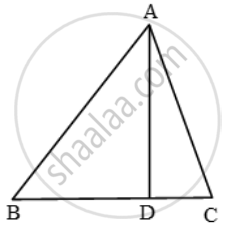
DB = 3CD
BC = BD + DC
The perpendicular AD on the base BC of a ∆ABC intersects BC at D so that DB = 3 CD. Prove that 2AC2 + BC2.
We have,
DB = 3CD
∴ BC = BD + DC
⇒ BC = 3 CD + CD
`⇒ BD = 4 CD ⇒ CD = \frac { 1 }{ 4 } BC`
`∴ CD = \frac { 1 }{ 4 } BC and BD = 3CD = \frac { 1 }{ 4 } BC ….(i)`
Since ∆ABD is a right triangle right-angled at D.
`∴ AB^2 = AD^2 + BD^2 ….(ii)`
Similarly, ∆ACD is a right triangle right angled at D.
`∴ AC^2 = AD^2 + CD^2 ….(iii)`
Subtracting equation (iii) from equation (ii) we get
`AB^2 – AC^2 = BD^2 – CD^2`
`⇒ AB^2 – AC^2 = ( \frac{3}{4}BC)^{2}-( \frac{1}{4}BC)^{2}[`
`⇒ AB^2 – AC^2 = \frac { 9 }{ 16 } BC^2 – \frac { 1 }{ 16 } BC^2`
`⇒ AB^2 – AC^2 = \frac { 1 }{ 2 } BC^2`
`⇒ 2(AB^2 – AC^2 ) = BC^2`
`⇒ 2AB^2 = 2AC^2 + BC^2`
उत्तर २
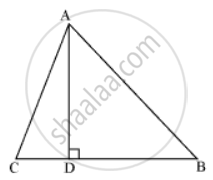
In ΔACD
AC2 = AD2 + DC2
AD2 = AC2 - DC2 ...(1)
In ΔABD
AB2 = AD2 + DB2
AD2 = AB2 - DB2 ...(2)
From equation (1) and (2)
Therefore AC2 - DC2 = AB2 - DB2
since given that 3DC = DB
DC = `"BC"/(4) and "DB" = (3"BC")/(4)`
`"AC"^2 - ("BC"/4)^2 = "AB"^2 - ((3"BC")/4)^2`
`"AC"^2 - "Bc"^2/(16) = "AB"^2 - (9"BC"^2)/(16)`
16AC2 - BC2 = 16AB2 - 9BC2
⇒ 16AB2 - 16AC2 = 8BC2
⇒ 2AB2 = 2AC2 + BC2.
APPEARS IN
संबंधित प्रश्न
In a right triangle ABC, right-angled at B, BC = 12 cm and AB = 5 cm. The radius of the circle inscribed in the triangle (in cm) is
(A) 4
(B) 3
(C) 2
(D) 1
D and E are points on the sides CA and CB respectively of a triangle ABC right angled at C. Prove that AE2 + BD2 = AB2 + DE2
Identify, with reason, if the following is a Pythagorean triplet.
(4, 9, 12)
In right angle ΔABC, if ∠B = 90°, AB = 6, BC = 8, then find AC.
Two poles of heights 6 m and 11 m stand vertically on a plane ground. If the distance between their feet is 12 m;
find the distance between their tips.
In an isosceles triangle ABC; AB = AC and D is the point on BC produced.
Prove that: AD2 = AC2 + BD.CD.
In Fig. 3, ∠ACB = 90° and CD ⊥ AB, prove that CD2 = BD x AD.

In the given figure, BL and CM are medians of a ∆ABC right-angled at A. Prove that 4 (BL2 + CM2) = 5 BC2.
The sides of a certain triangle is given below. Find, which of them is right-triangle
16 cm, 20 cm, and 12 cm
In the given figure, angle ACP = ∠BDP = 90°, AC = 12 m, BD = 9 m and PA= PB = 15 m. Find:
(i) CP
(ii) PD
(iii) CD

Show that the triangle ABC is a right-angled triangle; if: AB = 9 cm, BC = 40 cm and AC = 41 cm
Find the Pythagorean triplet from among the following set of numbers.
3, 4, 5
Find the Pythagorean triplet from among the following set of numbers.
4, 7, 8
In a triangle ABC, AC > AB, D is the midpoint BC, and AE ⊥ BC. Prove that: AB2 = AD2 - BC x CE + `(1)/(4)"BC"^2`
Two trains leave a railway station at the same time. The first train travels due west and the second train due north. The first train travels at a speed of `(20 "km")/"hr"` and the second train travels at `(30 "km")/"hr"`. After 2 hours, what is the distance between them?
In ∆PQR, PD ⊥ QR such that D lies on QR. If PQ = a, PR = b, QD = c and DR = d, prove that (a + b)(a – b) = (c + d)(c – d).
Prove that the area of the semicircle drawn on the hypotenuse of a right angled triangle is equal to the sum of the areas of the semicircles drawn on the other two sides of the triangle.
Prove that the area of the equilateral triangle drawn on the hypotenuse of a right angled triangle is equal to the sum of the areas of the equilateral triangles drawn on the other two sides of the triangle.
In the given figure, AD is a median of a triangle ABC and AM ⊥ BC. Prove that:

(i) `"AC"^2 = "AD"^2 + "BC"."DM" + (("BC")/2)^2`
(ii) `"AB"^2 = "AD"^2 - "BC"."DM" + (("BC")/2)^2`
(iii) `"AC"^2 + "AB"^2 = 2"AD"^2 + 1/2"BC"^2`
Two circles having same circumference are congruent.
