Advertisements
Advertisements
प्रश्न
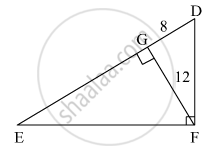
In the given figure, ∠DFE = 90°, FG ⊥ ED, If GD = 8, FG = 12, find (1) EG (2) FD and (3) EF
Advertisements
उत्तर
We know that,
In a right angled triangle, the perpendicular segment to the hypotenuse from the opposite vertex, is the geometric mean of the segments into which the hypotenuse is divided.
Here, seg GF ⊥ seg ED
\[\therefore {GF}^2 = EG \times GD\]
\[ \Rightarrow {12}^2 = EG \times 8\]
\[ \Rightarrow 144 = EG \times 8\]
\[ \Rightarrow EG = \frac{144}{8}\]
\[ \Rightarrow EG = 18\]
Hence, EG = 18.
Now,
According to Pythagoras theorem, in ∆DGF
\[{DG}^2 + {GF}^2 = {FD}^2 \]
\[ \Rightarrow 8^2 + {12}^2 = {FD}^2 \]
\[ \Rightarrow 64 + 144 = {FD}^2 \]
\[ \Rightarrow {FD}^2 = 208\]
\[ \Rightarrow FD = 4\sqrt{13}\]
In ∆EGF
\[{EG}^2 + {GF}^2 = {EF}^2 \]
\[ \Rightarrow {18}^2 + {12}^2 = {EF}^2 \]
\[ \Rightarrow 324 + 144 = {EF}^2 \]
\[ \Rightarrow {EF}^2 = 468\]
\[ \Rightarrow EF = 6\sqrt{13}\]
Hence, FD =\[4\sqrt{13}\] and EF=\[6\sqrt{13}\]
संबंधित प्रश्न
In a right triangle ABC, right-angled at B, BC = 12 cm and AB = 5 cm. The radius of the circle inscribed in the triangle (in cm) is ______.
ABCD is a rhombus. Prove that AB2 + BC2 + CD2 + DA2= AC2 + BD2
Sides of triangle are given below. Determine it is a right triangle or not? In case of a right triangle, write the length of its hypotenuse. 50 cm, 80 cm, 100 cm
Find the perimeter of the rectangle whose length is 40 cm and a diagonal is 41 cm.
Identify, with reason, if the following is a Pythagorean triplet.
(5, 12, 13)
Identify, with reason, if the following is a Pythagorean triplet.
(10, 24, 27)
In ∆ABC, ∠BAC = 90°, seg BL and seg CM are medians of ∆ABC. Then prove that:
4(BL2 + CM2) = 5 BC2

In the given figure, ∠B = 90°, XY || BC, AB = 12 cm, AY = 8cm and AX : XB = 1 : 2 = AY : YC.
Find the lengths of AC and BC.

In the given figure, BL and CM are medians of a ∆ABC right-angled at A. Prove that 4 (BL2 + CM2) = 5 BC2.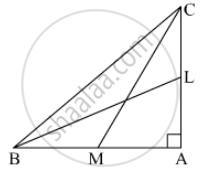
Triangle ABC is right-angled at vertex A. Calculate the length of BC, if AB = 18 cm and AC = 24 cm.
In the given figure, AD = 13 cm, BC = 12 cm, AB = 3 cm and angle ACD = angle ABC = 90°. Find the length of DC.
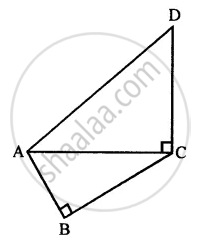
In the figure below, find the value of 'x'.
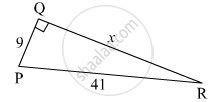
Find the length of the perpendicular of a triangle whose base is 5cm and the hypotenuse is 13cm. Also, find its area.
A man goes 10 m due east and then 24 m due north. Find the distance from the straight point.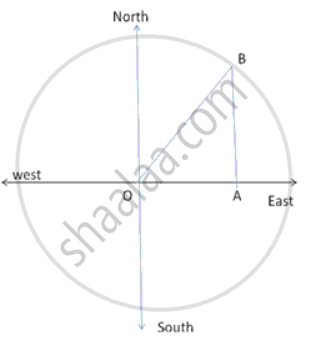
A point OI in the interior of a rectangle ABCD is joined with each of the vertices A, B, C and D. Prove that OB2 + OD2 = OC2 + OA2
In the figure, find AR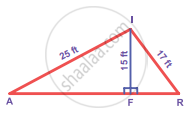
Prove that the area of the equilateral triangle drawn on the hypotenuse of a right angled triangle is equal to the sum of the areas of the equilateral triangles drawn on the other two sides of the triangle.
In a right-angled triangle ABC, if angle B = 90°, then which of the following is true?
Jayanti takes shortest route to her home by walking diagonally across a rectangular park. The park measures 60 metres × 80 metres. How much shorter is the route across the park than the route around its edges?
Points A and B are on the opposite edges of a pond as shown in the following figure. To find the distance between the two points, the surveyor makes a right-angled triangle as shown. Find the distance AB.

