Advertisements
Advertisements
प्रश्न
Find the Pythagorean triplet from among the following set of numbers.
2, 6, 7
Advertisements
उत्तर
It is known that, if in a triplet of natural numbers, the square of the biggest number is equal to the sum of the squares of the other two numbers, then the three numbers form a Pythagorean triplet.
The given set of numbers is (2, 6, 7).
The biggest number among the given set is 7.
72 = 49; 62 = 36; 22 = 4
Now, 4 + 36 = 40 ≠ 49
∴ 22 + 62 ≠ 72
Thus, (2, 6, 7) does not form a Pythagorean triplet.
संबंधित प्रश्न
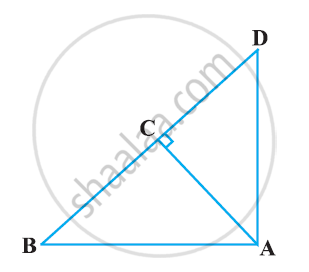
In Figure, ABD is a triangle right angled at A and AC ⊥ BD. Show that AB2 = BC × BD
In the given figure, AD is a median of a triangle ABC and AM ⊥ BC. Prove that:
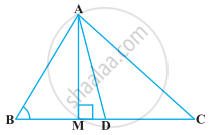
`"AC"^2 = "AD"^2 + "BC"."DM" + (("BC")/2)^2`
Which of the following can be the sides of a right triangle?
2.5 cm, 6.5 cm, 6 cm
In the case of right-angled triangles, identify the right angles.
In ∆PQR, point S is the midpoint of side QR. If PQ = 11, PR = 17, PS = 13, find QR.
Find the length of diagonal of the square whose side is 8 cm.
The sides of a certain triangle is given below. Find, which of them is right-triangle
6 m, 9 m, and 13 m
The length of the diagonals of rhombus are 24cm and 10cm. Find each side of the rhombus.
Find the distance between the helicopter and the ship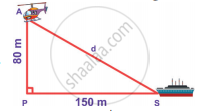
In the figure, find AR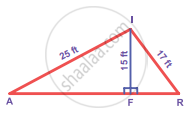
In the given figure, AD is a median of a triangle ABC and AM ⊥ BC. Prove that:
(i) `"AC"^2 = "AD"^2 + "BC"."DM" + (("BC")/2)^2`
(ii) `"AB"^2 = "AD"^2 - "BC"."DM" + (("BC")/2)^2`
(iii) `"AC"^2 + "AB"^2 = 2"AD"^2 + 1/2"BC"^2`
