Advertisements
Advertisements
Question
Find the Pythagorean triplet from among the following set of numbers.
2, 6, 7
Advertisements
Solution
It is known that, if in a triplet of natural numbers, the square of the biggest number is equal to the sum of the squares of the other two numbers, then the three numbers form a Pythagorean triplet.
The given set of numbers is (2, 6, 7).
The biggest number among the given set is 7.
72 = 49; 62 = 36; 22 = 4
Now, 4 + 36 = 40 ≠ 49
∴ 22 + 62 ≠ 72
Thus, (2, 6, 7) does not form a Pythagorean triplet.
RELATED QUESTIONS
PQR is a triangle right angled at P and M is a point on QR such that PM ⊥ QR. Show that PM2 = QM . MR
Prove that the sum of the squares of the sides of a rhombus is equal to the sum of the squares of its diagonals
D and E are points on the sides CA and CB respectively of a triangle ABC right angled at C. Prove that AE2 + BD2 = AB2 + DE2
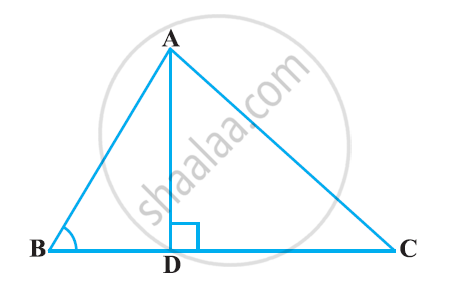
In the given figure, ABC is a triangle in which ∠ABC < 90° and AD ⊥ BC. Prove that AC2 = AB2 + BC2 − 2BC.BD.
Walls of two buildings on either side of a street are parallel to each other. A ladder 5.8 m long is placed on the street such that its top just reaches the window of a building at the height of 4 m. On turning the ladder over to the other side of the street, its top touches the window of the other building at a height 4.2 m. Find the width of the street.
If the sides of the triangle are in the ratio 1: `sqrt2`: 1, show that is a right-angled triangle.
M andN are the mid-points of the sides QR and PQ respectively of a PQR, right-angled at Q.
Prove that:
(i) PM2 + RN2 = 5 MN2
(ii) 4 PM2 = 4 PQ2 + QR2
(iii) 4 RN2 = PQ2 + 4 QR2(iv) 4 (PM2 + RN2) = 5 PR2
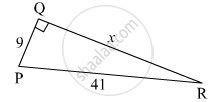
In the figure below, find the value of 'x'.
Find the length of the hypotenuse of a triangle whose other two sides are 24cm and 7cm.
A man goes 18 m due east and then 24 m due north. Find the distance of his current position from the starting point?
