Advertisements
Advertisements
Question
An isosceles triangle has equal sides each 13 cm and a base 24 cm in length. Find its height
Advertisements
Solution
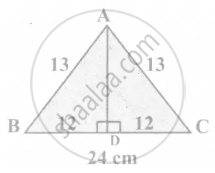
In an isosceles triangle the altitude dives its base into two equal parts.
Now in the figure, ∆ABC is an isosceles triangle with AD as its height
In the figure, AD is the altitude and ∆ABD is a right triangle.
By Pythagoras theorem,
AB2 = AD2 + BD2
⇒ AD2 = AB2 – BD2
= 132 – 122 = 169 – 144 = 25
AD2 = 25 = 52
Height: AD = 5 cm
APPEARS IN
RELATED QUESTIONS
An aeroplane leaves an airport and flies due north at a speed of 1,000 km per hour. At the same time, another aeroplane leaves the same airport and flies due west at a speed of 1,200 km per hour. How far apart will be the two planes after `1 1/2` hours?
Tick the correct answer and justify: In ΔABC, AB = `6sqrt3` cm, AC = 12 cm and BC = 6 cm.
The angle B is:
In ∆PQR, point S is the midpoint of side QR. If PQ = 11, PR = 17, PS = 13, find QR.
Some question and their alternative answer are given. Select the correct alternative.
If a, b, and c are sides of a triangle and a2 + b2 = c2, name the type of triangle.
In the following figure, AD is perpendicular to BC and D divides BC in the ratio 1: 3.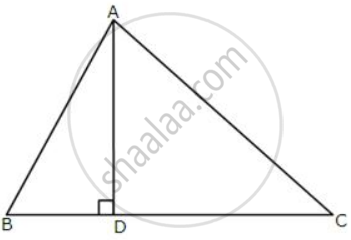
Prove that : 2AC2 = 2AB2 + BC2
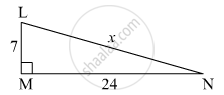
In the figure below, find the value of 'x'.
The sides of the triangle are given below. Find out which one is the right-angled triangle?
1.5, 1.6, 1.7
If length of sides of a triangle are a, b, c and a2 + b2 = c2, then which type of triangle it is?
From given figure, In ∆ABC, If AC = 12 cm, then AB = ?
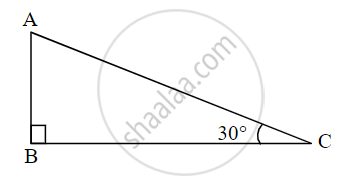
Activity: From given figure, In ∆ABC, ∠ABC = 90°, ∠ACB = 30°
∴ ∠BAC = `square`
∴ ∆ABC is 30° – 60° – 90° triangle.
∴ In ∆ABC by property of 30° – 60° – 90° triangle.
∴ AB = `1/2` AC and `square` = `sqrt(3)/2` AC
∴ `square` = `1/2 xx 12` and BC = `sqrt(3)/2 xx 12`
∴ `square` = 6 and BC = `6sqrt(3)`
In an equilateral triangle PQR, prove that PS2 = 3(QS)2.

