Advertisements
Advertisements
प्रश्न
An isosceles triangle has equal sides each 13 cm and a base 24 cm in length. Find its height
Advertisements
उत्तर
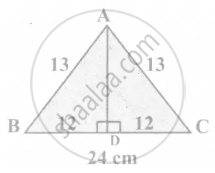
In an isosceles triangle the altitude dives its base into two equal parts.
Now in the figure, ∆ABC is an isosceles triangle with AD as its height
In the figure, AD is the altitude and ∆ABD is a right triangle.
By Pythagoras theorem,
AB2 = AD2 + BD2
⇒ AD2 = AB2 – BD2
= 132 – 122 = 169 – 144 = 25
AD2 = 25 = 52
Height: AD = 5 cm
APPEARS IN
संबंधित प्रश्न
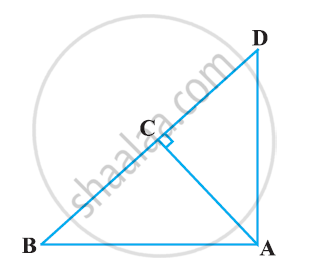
In Figure ABD is a triangle right angled at A and AC ⊥ BD. Show that AC2 = BC × DC
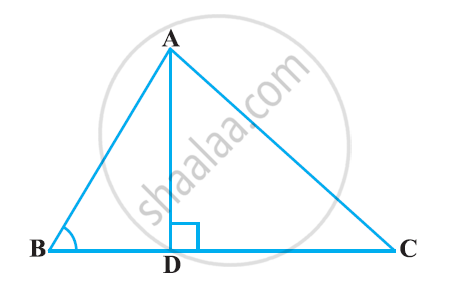
In the given figure, ABC is a triangle in which ∠ABC < 90° and AD ⊥ BC. Prove that AC2 = AB2 + BC2 − 2BC.BD.
Which of the following can be the sides of a right triangle?
2 cm, 2 cm, 5 cm
In the case of right-angled triangles, identify the right angles.
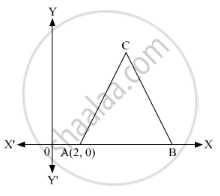
In the given figure, ∆ABC is an equilateral triangle of side 3 units. Find the coordinates of the other two vertices ?
Find the value of (sin2 33 + sin2 57°)
In the right-angled ∆PQR, ∠ P = 90°. If l(PQ) = 24 cm and l(PR) = 10 cm, find the length of seg QR.
The sides of the triangle are given below. Find out which one is the right-angled triangle?
40, 20, 30
The perimeters of two similar triangles ABC and PQR are 60 cm and 36 cm respectively. If PQ = 9 cm, then AB equals ______.
A flag pole 18 m high casts a shadow 9.6 m long. Find the distance of the top of the pole from the far end of the shadow.
Two circles having same circumference are congruent.
