Advertisements
Advertisements
प्रश्न
A boy first goes 5 m due north and then 12 m due east. Find the distance between the initial and the final position of the boy.
Advertisements
उत्तर
Given: Direction of north = 5 m i.e. AC Direction of east = 12 m i.e. AB

To find: BC
According to Pythagoras Theorem,
In right angled Δ ABC
(BC)2 = (AC)2 + (AB)2
(BC)2 = (5)2 + (12)2
(BC)2 = 25 + 144
(BC)2= 169
∴ BC = `sqrt169=sqrt(13xx13)` = 13 m
APPEARS IN
संबंधित प्रश्न
The perpendicular from A on side BC of a Δ ABC intersects BC at D such that DB = 3CD . Prove that 2AB2 = 2AC2 + BC2.
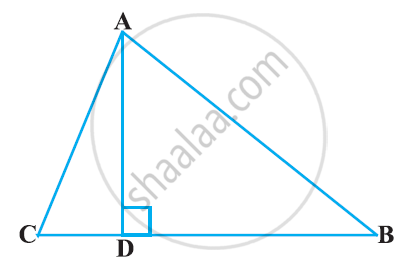
Which of the following can be the sides of a right triangle?
1.5 cm, 2 cm, 2.5 cm
In the case of right-angled triangles, identify the right angles.
In right angle ΔABC, if ∠B = 90°, AB = 6, BC = 8, then find AC.
In triangle ABC, AB = AC and BD is perpendicular to AC.
Prove that: BD2 − CD2 = 2CD × AD
The sides of a certain triangle is given below. Find, which of them is right-triangle
16 cm, 20 cm, and 12 cm
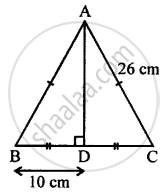
In the given figure, angle ADB = 90°, AC = AB = 26 cm and BD = DC. If the length of AD = 24 cm; find the length of BC.
Find the Pythagorean triplet from among the following set of numbers.
3, 4, 5
Two poles of height 9m and 14m stand on a plane ground. If the distance between their 12m, find the distance between their tops.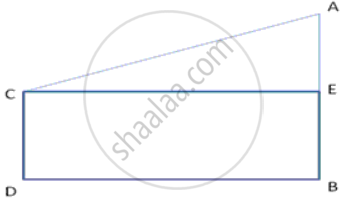
The hypotenuse (in cm) of a right angled triangle is 6 cm more than twice the length of the shortest side. If the length of third side is 6 cm less than thrice the length of shortest side, then find the dimensions of the triangle.
Height of a pole is 8 m. Find the length of rope tied with its top from a point on the ground at a distance of 6 m from its bottom.
