Advertisements
Advertisements
Question
A boy first goes 5 m due north and then 12 m due east. Find the distance between the initial and the final position of the boy.
Advertisements
Solution
Given: Direction of north = 5 m i.e. AC Direction of east = 12 m i.e. AB

To find: BC
According to Pythagoras Theorem,
In right angled Δ ABC
(BC)2 = (AC)2 + (AB)2
(BC)2 = (5)2 + (12)2
(BC)2 = 25 + 144
(BC)2= 169
∴ BC = `sqrt169=sqrt(13xx13)` = 13 m
APPEARS IN
RELATED QUESTIONS
A man goes 10 m due east and then 24 m due north. Find the distance from the starting point
Sides of triangle are given below. Determine it is a right triangle or not? In case of a right triangle, write the length of its hypotenuse. 50 cm, 80 cm, 100 cm
ABC is an equilateral triangle of side 2a. Find each of its altitudes.
Prove that, in a right-angled triangle, the square of the hypotenuse is equal to the sum of the square of remaining two sides.
In right angle ΔABC, if ∠B = 90°, AB = 6, BC = 8, then find AC.
A man goes 40 m due north and then 50 m due west. Find his distance from the starting point.
Choose the correct alternative:
In right-angled triangle PQR, if hypotenuse PR = 12 and PQ = 6, then what is the measure of ∠P?
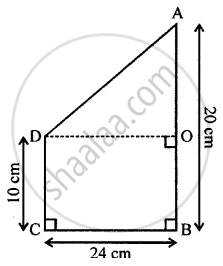
Use the information given in the figure to find the length AD.
Each side of rhombus is 10cm. If one of its diagonals is 16cm, find the length of the other diagonals.
For going to a city B from city A, there is a route via city C such that AC ⊥ CB, AC = 2x km and CB = 2(x + 7) km. It is proposed to construct a 26 km highway which directly connects the two cities A and B. Find how much distance will be saved in reaching city B from city A after the construction of the highway.
