Advertisements
Advertisements
Question
The foot of a ladder is 6 m away from its wall and its top reaches a window 8 m above the ground. If the ladder is shifted in such a way that its foot is 8 m away from the wall, to what height does its top reach?
Advertisements
Solution
Let the height of the top be x m.
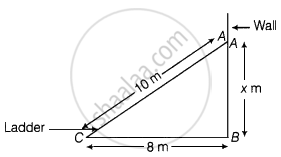
In right angled ΔACB,
AC2 = AB2 + BC2 ...[By Pythagoras theorem]
⇒ AB2 = AC2 – BC2
⇒ x2 = (10)2 – (8)2 = 100 – 64
⇒ x = `sqrt(36)`
⇒ x = 6 m
Hence, the height of the top is 6 m.
APPEARS IN
RELATED QUESTIONS
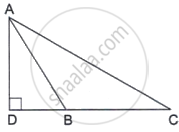
In the given figure, ∆ABC is an obtuse triangle, obtuse-angled at B. If AD ⊥ CB (produced) prove that AC2 = AB2 + BC2 + 2BC · BD.
In an equilateral triangle ABC, D is a point on side BC such that BD = `1/3BC` . Prove that 9 AD2 = 7 AB2
Identify, with reason, if the following is a Pythagorean triplet.
(24, 70, 74)
Some question and their alternative answer are given. Select the correct alternative.
If a, b, and c are sides of a triangle and a2 + b2 = c2, name the type of triangle.
In triangle PQR, angle Q = 90°, find: PQ, if PR = 34 cm and QR = 30 cm
Find the Pythagorean triplet from among the following set of numbers.
2, 6, 7
In a triangle ABC, AC > AB, D is the midpoint BC, and AE ⊥ BC. Prove that: AC2 = AD2 + BC x DE + `(1)/(4)"BC"^2`
If in a ΔPQR, PR2 = PQ2 + QR2, then the right angle of ∆PQR is at the vertex ________
In triangle ABC, line I, is a perpendicular bisector of BC.
If BC = 12 cm, SM = 8 cm, find CS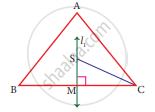
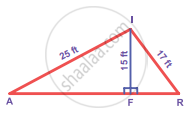
In the figure, find AR