Advertisements
Advertisements
Question
The sides of the triangle are given below. Find out which one is the right-angled triangle?
1.5, 1.6, 1.7
Advertisements
Solution
It is known that, if in a triplet of natural numbers, the square of the biggest number is equal to the sum of the squares of the other two numbers, then the three numbers form a Pythagorean triplet. If the lengths of the sides of a triangle form such a triplet, then the triangle is a right-angled triangle.
The sides of the given triangle are 1.5, 1.6, and 1.7.
Let us check whether the given set (1.5, 1.6, 1.7) forms a Pythagorean triplet or not.
The biggest number among the given set is 1.7.
(1.7)2 = 2.89; (1.5)2 = 2.25; (1.6)2 = 2.56
Now, 2.25 + 2.56 = 4.81 ≠ 2.89
∴ (1.5)2 + (1.6)2 ≠ (1.7)2
Thus, (1.5, 1.6, 1.7) does not form a Pythagorean triplet.
Hence, the given triangle with sides 1.5, 1.6, and 1.7 is not a right-angled triangle.
RELATED QUESTIONS
Sides of triangle are given below. Determine it is a right triangle or not? In case of a right triangle, write the length of its hypotenuse. 50 cm, 80 cm, 100 cm
PQR is a triangle right angled at P and M is a point on QR such that PM ⊥ QR. Show that PM2 = QM . MR
Two poles of heights 6 m and 11 m stand on a plane ground. If the distance between the feet of the poles is 12 m, find the distance between their tops.
Pranali and Prasad started walking to the East and to the North respectively, from the same point and at the same speed. After 2 hours distance between them was \[15\sqrt{2}\]
km. Find their speed per hour.
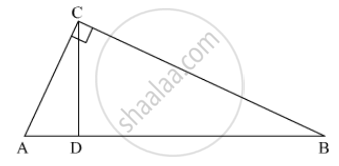
In Fig. 3, ∠ACB = 90° and CD ⊥ AB, prove that CD2 = BD x AD.
The sides of the triangle are given below. Find out which one is the right-angled triangle?
40, 20, 30
In a right-angled triangle ABC,ABC = 90°, AC = 10 cm, BC = 6 cm and BC produced to D such CD = 9 cm. Find the length of AD.
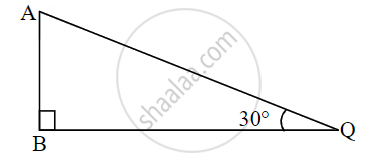
From the given figure, in ∆ABQ, if AQ = 8 cm, then AB = ?
If S is a point on side PQ of a ΔPQR such that PS = QS = RS, then ______.
Two trees 7 m and 4 m high stand upright on a ground. If their bases (roots) are 4 m apart, then the distance between their tops is ______.
