Advertisements
Advertisements
प्रश्न
The sides of the triangle are given below. Find out which one is the right-angled triangle?
1.5, 1.6, 1.7
Advertisements
उत्तर
It is known that, if in a triplet of natural numbers, the square of the biggest number is equal to the sum of the squares of the other two numbers, then the three numbers form a Pythagorean triplet. If the lengths of the sides of a triangle form such a triplet, then the triangle is a right-angled triangle.
The sides of the given triangle are 1.5, 1.6, and 1.7.
Let us check whether the given set (1.5, 1.6, 1.7) forms a Pythagorean triplet or not.
The biggest number among the given set is 1.7.
(1.7)2 = 2.89; (1.5)2 = 2.25; (1.6)2 = 2.56
Now, 2.25 + 2.56 = 4.81 ≠ 2.89
∴ (1.5)2 + (1.6)2 ≠ (1.7)2
Thus, (1.5, 1.6, 1.7) does not form a Pythagorean triplet.
Hence, the given triangle with sides 1.5, 1.6, and 1.7 is not a right-angled triangle.
संबंधित प्रश्न
ABC is a right triangle right-angled at C. Let BC = a, CA = b, AB = c and let p be the length of perpendicular from C on AB, prove that
(i) cp = ab
`(ii) 1/p^2=1/a^2+1/b^2`
PQR is a triangle right angled at P and M is a point on QR such that PM ⊥ QR. Show that PM2 = QM . MR
A tree is broken at a height of 5 m from the ground and its top touches the ground at a distance of 12 m from the base of the tree. Find the original height of the tree.
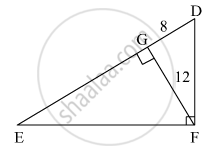
In the given figure, ∠DFE = 90°, FG ⊥ ED, If GD = 8, FG = 12, find (1) EG (2) FD and (3) EF
In the given figure, AB//CD, AB = 7 cm, BD = 25 cm and CD = 17 cm;
find the length of side BC.
Triangle PQR is right-angled at vertex R. Calculate the length of PR, if: PQ = 34 cm and QR = 33.6 cm.
The sides of a certain triangle is given below. Find, which of them is right-triangle
16 cm, 20 cm, and 12 cm
In a triangle ABC right angled at C, P and Q are points of sides CA and CB respectively, which divide these sides the ratio 2 : 1.
Prove that : 9(AQ2 + BP2) = 13AB2
Two rectangles are congruent, if they have same ______ and ______.
If the areas of two circles are the same, they are congruent.
