Advertisements
Advertisements
प्रश्न
Points A and B are on the opposite edges of a pond as shown in the following figure. To find the distance between the two points, the surveyor makes a right-angled triangle as shown. Find the distance AB.

Advertisements
उत्तर
Since, ΔACD is a right angled triangle.
In right angled ΔADC, by Pythagoras theorem,
(AC)2 = (AD)2 + (CD)2
⇒ (AC)2 + (30)2 + (40)2 ...[∵ AD = 30 cm and CD = 40 cm, given]
⇒ (AC)2 = 900 + 1600
⇒ (AC)2 = 2500
⇒ AC = `sqrt(2500)`
∴ AC = 50 m
Now, AB = AC – BC = 50 – 12 = 38 m
Hence, the distance AB is 38 m.
APPEARS IN
संबंधित प्रश्न
Side of a triangle is given, determine it is a right triangle.
`(2a – 1) cm, 2\sqrt { 2a } cm, and (2a + 1) cm`
An aeroplane leaves an airport and flies due north at a speed of 1,000 km per hour. At the same time, another aeroplane leaves the same airport and flies due west at a speed of 1,200 km per hour. How far apart will be the two planes after `1 1/2` hours?
Prove that the points A(0, −1), B(−2, 3), C(6, 7) and D(8, 3) are the vertices of a rectangle ABCD?
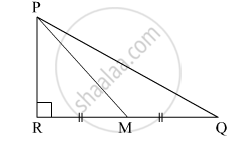
In the given figure, M is the midpoint of QR. ∠PRQ = 90°. Prove that, PQ2 = 4PM2 – 3PR2.
Triangle XYZ is right-angled at vertex Z. Calculate the length of YZ, if XY = 13 cm and XZ = 12 cm.
Find the length of the hypotenuse of a triangle whose other two sides are 24cm and 7cm.
Calculate the area of a right-angled triangle whose hypotenuse is 65cm and one side is 16cm.
A point OI in the interior of a rectangle ABCD is joined with each of the vertices A, B, C and D. Prove that OB2 + OD2 = OC2 + OA2
A man goes 18 m due east and then 24 m due north. Find the distance of his current position from the starting point?
Jiya walks 6 km due east and then 8 km due north. How far is she from her starting place?
