Advertisements
Advertisements
Question
Points A and B are on the opposite edges of a pond as shown in the following figure. To find the distance between the two points, the surveyor makes a right-angled triangle as shown. Find the distance AB.

Advertisements
Solution
Since, ΔACD is a right angled triangle.
In right angled ΔADC, by Pythagoras theorem,
(AC)2 = (AD)2 + (CD)2
⇒ (AC)2 + (30)2 + (40)2 ...[∵ AD = 30 cm and CD = 40 cm, given]
⇒ (AC)2 = 900 + 1600
⇒ (AC)2 = 2500
⇒ AC = `sqrt(2500)`
∴ AC = 50 m
Now, AB = AC – BC = 50 – 12 = 38 m
Hence, the distance AB is 38 m.
APPEARS IN
RELATED QUESTIONS
In triangle ABC, ∠C=90°. Let BC= a, CA= b, AB= c and let 'p' be the length of the perpendicular from 'C' on AB, prove that:
1. cp = ab
2. `1/p^2=1/a^2+1/b^2`
Sides of triangle are given below. Determine it is a right triangle or not? In case of a right triangle, write the length of its hypotenuse. 7 cm, 24 cm, 25 cm
Prove that the sum of the squares of the diagonals of parallelogram is equal to the sum of the squares of its sides.
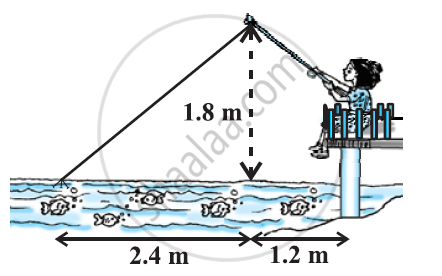
Nazima is fly fishing in a stream. The tip of her fishing rod is 1.8 m above the surface of the water and the fly at the end of the string rests on the water 3.6 m away and 2.4 m from a point directly under the tip of the rod. Assuming that her string (from the tip of her rod to the fly) is taut, how much string does she have out (see Figure)? If she pulls in the string at the rate of 5 cm per second, what will be the horizontal distance of the fly from her after 12 seconds?
PQR is a triangle right angled at P. If PQ = 10 cm and PR = 24 cm, find QR.
Prove that, in a right-angled triangle, the square of the hypotenuse is equal to the sum of the square of remaining two sides.
Each side of rhombus is 10cm. If one of its diagonals is 16cm, find the length of the other diagonals.
If ‘l‘ and ‘m’ are the legs and ‘n’ is the hypotenuse of a right angled triangle then, l2 = ________
From given figure, In ∆ABC, If AC = 12 cm, then AB = ?
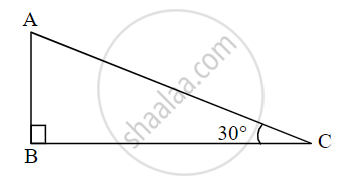
Activity: From given figure, In ∆ABC, ∠ABC = 90°, ∠ACB = 30°
∴ ∠BAC = `square`
∴ ∆ABC is 30° – 60° – 90° triangle.
∴ In ∆ABC by property of 30° – 60° – 90° triangle.
∴ AB = `1/2` AC and `square` = `sqrt(3)/2` AC
∴ `square` = `1/2 xx 12` and BC = `sqrt(3)/2 xx 12`
∴ `square` = 6 and BC = `6sqrt(3)`
If the areas of two circles are the same, they are congruent.
