Advertisements
Advertisements
Question
In a triangle ABC, AC > AB, D is the midpoint BC, and AE ⊥ BC. Prove that: AB2 = AD2 - BC x CE + `(1)/(4)"BC"^2`
Sum
Advertisements
Solution
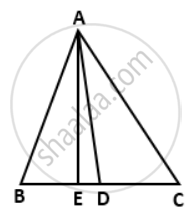
We have ∠AED = 90°
∴ ∠ADE < 90° and ∠ADC > 90°
i.e. ∠ADE is acute and ∠ADC is obtuse.
In ΔABD, ∠ADE is an acute angle.
∴ AB2 = AD2 + BD2 - 2 x BD x DE
⇒ AB2 = AD2 + `(1/2"BC")^2 - 2 xx (1)/(2)"BC" xx "DE"`
⇒ AB2 = AD2 + `(1)/(4)"BC"^2 - "BC" xx "DE"`
⇒ AB2 = AD2 + BC x DE - `(1)/(4)"BC"^2`. ....(ii)
shaalaa.com
Is there an error in this question or solution?
