Advertisements
Advertisements
Question
The sides of the triangle are given below. Find out which one is the right-angled triangle?
40, 20, 30
Advertisements
Solution
It is known that, if in a triplet of natural numbers, the square of the biggest number is equal to the sum of the squares of the other two numbers, then the three numbers form a Pythagorean triplet. If the lengths of the sides of a triangle form such a triplet, then the triangle is a right-angled triangle.
The sides of the given triangle are 40, 20, and 30.
Let us check whether the given set (40, 20, 30) forms a Pythagorean triplet or not.
The biggest number among the given set is 40.
(40)2 = 1600; (20)2 = 400; (30)2 = 900
Now, 400 + 900 = 1300 ≠ 1600
∴ (20)2 + (30)2 ≠ (40)2
Thus, (40, 20, 30) does not form a Pythagorean triplet.
Hence, the given triangle with sides 40, 20, and 30 is not a right-angled triangle.
RELATED QUESTIONS
Prove that the sum of the squares of the sides of a rhombus is equal to the sum of the squares of its diagonals
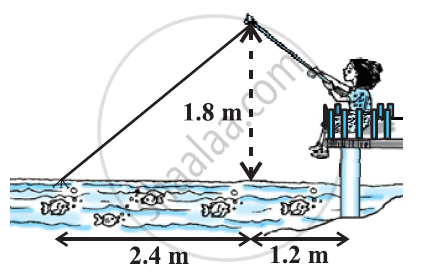
Nazima is fly fishing in a stream. The tip of her fishing rod is 1.8 m above the surface of the water and the fly at the end of the string rests on the water 3.6 m away and 2.4 m from a point directly under the tip of the rod. Assuming that her string (from the tip of her rod to the fly) is taut, how much string does she have out (see Figure)? If she pulls in the string at the rate of 5 cm per second, what will be the horizontal distance of the fly from her after 12 seconds?
Identify, with reason, if the following is a Pythagorean triplet.
(24, 70, 74)
Identify, with reason, if the following is a Pythagorean triplet.
(11, 60, 61)
Find the length diagonal of a rectangle whose length is 35 cm and breadth is 12 cm.
In the given figure, AB//CD, AB = 7 cm, BD = 25 cm and CD = 17 cm;
find the length of side BC.
In the right-angled ∆PQR, ∠ P = 90°. If l(PQ) = 24 cm and l(PR) = 10 cm, find the length of seg QR.
Find the Pythagorean triplet from among the following set of numbers.
9, 40, 41
For going to a city B from city A, there is a route via city C such that AC ⊥ CB, AC = 2x km and CB = 2(x + 7) km. It is proposed to construct a 26 km highway which directly connects the two cities A and B. Find how much distance will be saved in reaching city B from city A after the construction of the highway.
In the given figure, AD is a median of a triangle ABC and AM ⊥ BC. Prove that:
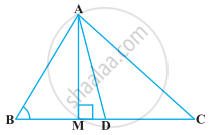
(i) `"AC"^2 = "AD"^2 + "BC"."DM" + (("BC")/2)^2`
(ii) `"AB"^2 = "AD"^2 - "BC"."DM" + (("BC")/2)^2`
(iii) `"AC"^2 + "AB"^2 = 2"AD"^2 + 1/2"BC"^2`
