Advertisements
Advertisements
Question
In ΔABC, Find the sides of the triangle, if:
- AB = ( x - 3 ) cm, BC = ( x + 4 ) cm and AC = ( x + 6 ) cm
- AB = x cm, BC = ( 4x + 4 ) cm and AC = ( 4x + 5) cm
Advertisements
Solution
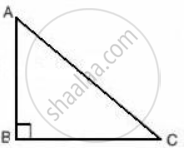
(i) In right-angled ΔABC,
AC2 = AB2 + BC2
⇒ ( x + 6 )2 = ( x - 3 )2 + ( x + 4 )2
⇒ ( x2 + 12x + 36 ) = ( x2 - 6x + 9 ) + ( x2 + 8x + 16 )
⇒ x2 - 10x - 11 = 0
⇒ ( x - 11 )( x + 1 ) = 0
⇒ x = 11 or x = - 1
But length of the side of a triangle can not be negative.
⇒ x = 11 cm
∴ AB = ( x - 3 ) = ( 11 - 3 ) = 8 cm
BC = ( x + 4 ) = ( 11 + 4 ) = 15 cm
AC = ( x + 6 ) = ( 11 + 6 ) = 17 cm.
(ii) In right-angled ΔABC,
AC2 = AB2 + BC2
⇒ ( 4x + 5 )2 = ( x )2 + ( 4x + 4 )2
⇒ ( 16x2 + 40x + 25 ) = ( x2 ) + ( 16x2 + 32x + 16 )
⇒ x2 - 8x - 9 = 0
⇒ ( x - 9 )( x + 1 ) = 0
⇒ x = 9 or x = - 1
But length of the side of a triangle can not be negative.
⇒ x = 9 cm
∴ AB = x = 9 cm
BC = ( 4x + 4 ) = ( 36 + 4 ) = 40 cm
AC = ( 4x + 5 ) = ( 36 + 5 ) = 41 cm.
APPEARS IN
RELATED QUESTIONS
In Fig., ∆ABC is an obtuse triangle, obtuse angled at B. If AD ⊥ CB, prove that AC2 = AB2 + BC2 + 2BC × BD
Sides of triangle are given below. Determine it is a right triangle or not? In case of a right triangle, write the length of its hypotenuse. 7 cm, 24 cm, 25 cm
D and E are points on the sides CA and CB respectively of a triangle ABC right angled at C. Prove that AE2 + BD2 = AB2 + DE2
Tick the correct answer and justify: In ΔABC, AB = `6sqrt3` cm, AC = 12 cm and BC = 6 cm.
The angle B is:
Which of the following can be the sides of a right triangle?
2.5 cm, 6.5 cm, 6 cm
In the case of right-angled triangles, identify the right angles.
In the figure: ∠PSQ = 90o, PQ = 10 cm, QS = 6 cm and RQ = 9 cm. Calculate the length of PR.
AD is drawn perpendicular to base BC of an equilateral triangle ABC. Given BC = 10 cm, find the length of AD, correct to 1 place of decimal.
In the following figure, AD is perpendicular to BC and D divides BC in the ratio 1: 3.
Prove that : 2AC2 = 2AB2 + BC2
In triangle ABC, angle A = 90o, CA = AB and D is the point on AB produced.
Prove that DC2 - BD2 = 2AB.AD.
O is any point inside a rectangle ABCD.
Prove that: OB2 + OD2 = OC2 + OA2.
In a quadrilateral ABCD, ∠B = 90° and ∠D = 90°.
Prove that: 2AC2 - AB2 = BC2 + CD2 + DA2
In the following Figure ∠ACB= 90° and CD ⊥ AB, prove that CD2 = BD × AD

In Fig. 3, ∠ACB = 90° and CD ⊥ AB, prove that CD2 = BD x AD.

In the given figure, AD = 13 cm, BC = 12 cm, AB = 3 cm and angle ACD = angle ABC = 90°. Find the length of DC.

The sides of the triangle are given below. Find out which one is the right-angled triangle?
1.5, 1.6, 1.7
Find the length of the perpendicular of a triangle whose base is 5cm and the hypotenuse is 13cm. Also, find its area.
A man goes 18 m due east and then 24 m due north. Find the distance of his current position from the starting point?
There are two paths that one can choose to go from Sarah’s house to James's house. One way is to take C street, and the other way requires to take B street and then A street. How much shorter is the direct path along C street?

Prove that the area of the equilateral triangle drawn on the hypotenuse of a right angled triangle is equal to the sum of the areas of the equilateral triangles drawn on the other two sides of the triangle.
Jayanti takes shortest route to her home by walking diagonally across a rectangular park. The park measures 60 metres × 80 metres. How much shorter is the route across the park than the route around its edges?
