Advertisements
Advertisements
प्रश्न
In ΔABC, Find the sides of the triangle, if:
- AB = ( x - 3 ) cm, BC = ( x + 4 ) cm and AC = ( x + 6 ) cm
- AB = x cm, BC = ( 4x + 4 ) cm and AC = ( 4x + 5) cm
Advertisements
उत्तर
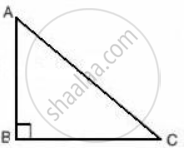
(i) In right-angled ΔABC,
AC2 = AB2 + BC2
⇒ ( x + 6 )2 = ( x - 3 )2 + ( x + 4 )2
⇒ ( x2 + 12x + 36 ) = ( x2 - 6x + 9 ) + ( x2 + 8x + 16 )
⇒ x2 - 10x - 11 = 0
⇒ ( x - 11 )( x + 1 ) = 0
⇒ x = 11 or x = - 1
But length of the side of a triangle can not be negative.
⇒ x = 11 cm
∴ AB = ( x - 3 ) = ( 11 - 3 ) = 8 cm
BC = ( x + 4 ) = ( 11 + 4 ) = 15 cm
AC = ( x + 6 ) = ( 11 + 6 ) = 17 cm.
(ii) In right-angled ΔABC,
AC2 = AB2 + BC2
⇒ ( 4x + 5 )2 = ( x )2 + ( 4x + 4 )2
⇒ ( 16x2 + 40x + 25 ) = ( x2 ) + ( 16x2 + 32x + 16 )
⇒ x2 - 8x - 9 = 0
⇒ ( x - 9 )( x + 1 ) = 0
⇒ x = 9 or x = - 1
But length of the side of a triangle can not be negative.
⇒ x = 9 cm
∴ AB = x = 9 cm
BC = ( 4x + 4 ) = ( 36 + 4 ) = 40 cm
AC = ( 4x + 5 ) = ( 36 + 5 ) = 41 cm.
APPEARS IN
संबंधित प्रश्न
Two towers of heights 10 m and 30 m stand on a plane ground. If the distance between their feet is 15 m, find the distance between their tops
ABC is an isosceles triangle right angled at C. Prove that AB2 = 2AC2
An aeroplane leaves an airport and flies due north at a speed of 1,000 km per hour. At the same time, another aeroplane leaves the same airport and flies due west at a speed of 1,200 km per hour. How far apart will be the two planes after `1 1/2` hours?
Identify, with reason, if the following is a Pythagorean triplet.
(3, 5, 4)
Pranali and Prasad started walking to the East and to the North respectively, from the same point and at the same speed. After 2 hours distance between them was \[15\sqrt{2}\]
km. Find their speed per hour.
Two poles of heights 6 m and 11 m stand vertically on a plane ground. If the distance between their feet is 12 m;
find the distance between their tips.
In a quadrilateral ABCD, ∠B = 90° and ∠D = 90°.
Prove that: 2AC2 - AB2 = BC2 + CD2 + DA2
Triangle ABC is right-angled at vertex A. Calculate the length of BC, if AB = 18 cm and AC = 24 cm.
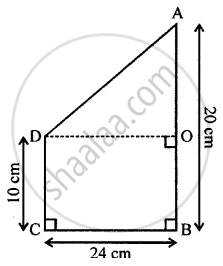
Use the information given in the figure to find the length AD.
Find the Pythagorean triplet from among the following set of numbers.
4, 7, 8
In a triangle ABC right angled at C, P and Q are points of sides CA and CB respectively, which divide these sides the ratio 2 : 1.
Prove that: 9AQ2 = 9AC2 + 4BC2
The perpendicular PS on the base QR of a ∆PQR intersects QR at S, such that QS = 3 SR. Prove that 2PQ2 = 2PR2 + QR2
Find the unknown side in the following triangles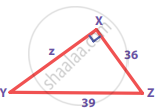
For going to a city B from city A, there is a route via city C such that AC ⊥ CB, AC = 2x km and CB = 2(x + 7) km. It is proposed to construct a 26 km highway which directly connects the two cities A and B. Find how much distance will be saved in reaching city B from city A after the construction of the highway.
A flag pole 18 m high casts a shadow 9.6 m long. Find the distance of the top of the pole from the far end of the shadow.
Prove that the area of the semicircle drawn on the hypotenuse of a right angled triangle is equal to the sum of the areas of the semicircles drawn on the other two sides of the triangle.
Lengths of sides of a triangle are 3 cm, 4 cm and 5 cm. The triangle is ______.
A right-angled triangle may have all sides equal.
Height of a pole is 8 m. Find the length of rope tied with its top from a point on the ground at a distance of 6 m from its bottom.
