Advertisements
Advertisements
प्रश्न
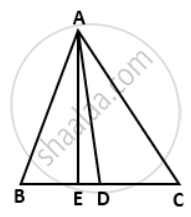
In a triangle ABC, AC > AB, D is the midpoint BC, and AE ⊥ BC. Prove that: AB2 + AC2 = 2(AD2 + CD2)
Advertisements
उत्तर

We have ∠AED = 90°
∴ ∠ADE < 90° and ∠ADC > 90°
i.e. ∠ADE is acute and ∠ADC is obtuse.
From (iii), we have
AB2 + AC2 = `2"AD"^2 + (1)/(2)"BC"^2`
⇒ AB2 + AC2 = `2"AD"^2 + (1)/(2)(2 xx "CD")^2`
⇒ AB2 + AC2 = `2"AD"^2 + (1)/(2) xx 4"CD"^2`
⇒ AB2 + AC2 = 2AD2 + 2CD2
⇒ AB2 + AC2 = 2(AD2 + CD2).
APPEARS IN
संबंधित प्रश्न
ABC is a right triangle right-angled at C. Let BC = a, CA = b, AB = c and let p be the length of perpendicular from C on AB, prove that
(i) cp = ab
`(ii) 1/p^2=1/a^2+1/b^2`
ABC is a triangle right angled at C. If AB = 25 cm and AC = 7 cm, find BC.
In ∆ABC, ∠BAC = 90°, seg BL and seg CM are medians of ∆ABC. Then prove that:
4(BL2 + CM2) = 5 BC2

In triangle ABC, given below, AB = 8 cm, BC = 6 cm and AC = 3 cm. Calculate the length of OC.

ABC is a triangle, right-angled at B. M is a point on BC.
Prove that: AM2 + BC2 = AC2 + BM2
In ∆ ABC, AD ⊥ BC.
Prove that AC2 = AB2 +BC2 − 2BC x BD
In the figure below, find the value of 'x'.

In the right-angled ∆PQR, ∠ P = 90°. If l(PQ) = 24 cm and l(PR) = 10 cm, find the length of seg QR.
Find the Pythagorean triplet from among the following set of numbers.
4, 5, 6
In a triangle ABC, AC > AB, D is the midpoint BC, and AE ⊥ BC. Prove that: AC2 = AD2 + BC x DE + `(1)/(4)"BC"^2`
In a right-angled triangle PQR, right-angled at Q, S and T are points on PQ and QR respectively such as PT = SR = 13 cm, QT = 5 cm and PS = TR. Find the length of PQ and PS.
To get from point A to point B you must avoid walking through a pond. You must walk 34 m south and 41 m east. To the nearest meter, how many meters would be saved if it were possible to make a way through the pond?
If in a ΔPQR, PR2 = PQ2 + QR2, then the right angle of ∆PQR is at the vertex ________
In a right angled triangle, the hypotenuse is the greatest side
If ΔABC ~ ΔPQR, `("ar" triangle "ABC")/("ar" triangle "PQR") = 9/4` and AB = 18 cm, then the length of PQ is ______.
Prove that the area of the semicircle drawn on the hypotenuse of a right angled triangle is equal to the sum of the areas of the semicircles drawn on the other two sides of the triangle.
Two trees 7 m and 4 m high stand upright on a ground. If their bases (roots) are 4 m apart, then the distance between their tops is ______.
In a right-angled triangle ABC, if angle B = 90°, then which of the following is true?
If the hypotenuse of one right triangle is equal to the hypotenuse of another right triangle, then the triangles are congruent.