Advertisements
Advertisements
प्रश्न
Find the Pythagorean triplet from among the following set of numbers.
4, 7, 8
Advertisements
उत्तर
It is known that, if in a triplet of natural numbers, the square of the biggest number is equal to the sum of the squares of the other two numbers, then the three numbers form a Pythagorean triplet.
The given set of numbers is (4, 7, 8).
The biggest number among the given set is 8.
82 = 64; 72 = 49; 42 = 16
Now, 16 + 49 = 65 ≠ 64
∴ 42 + 72 ≠ 82
Thus, (4, 7, 8) does not form a Pythagorean triplet.
संबंधित प्रश्न
ABCD is a rectangle whose three vertices are B (4, 0), C(4, 3) and D(0,3). The length of one of its diagonals is
(A) 5
(B) 4
(C) 3
(D) 25
Tick the correct answer and justify: In ΔABC, AB = `6sqrt3` cm, AC = 12 cm and BC = 6 cm.
The angle B is:
Digonals of parallelogram WXYZ intersect at point O. If OY =5, find WY.
In the given figure, BL and CM are medians of a ∆ABC right-angled at A. Prove that 4 (BL2 + CM2) = 5 BC2.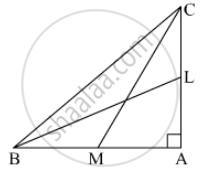
Find the Pythagorean triplet from among the following set of numbers.
3, 4, 5
In the given figure, PQ = `"RS"/(3)` = 8cm, 3ST = 4QT = 48cm.
SHow that ∠RTP = 90°.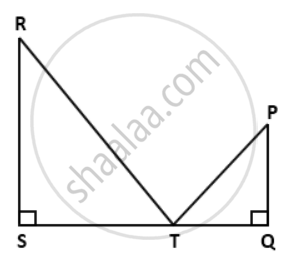
In the given figure. PQ = PS, P =R = 90°. RS = 20 cm and QR = 21 cm. Find the length of PQ correct to two decimal places.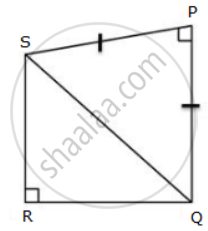
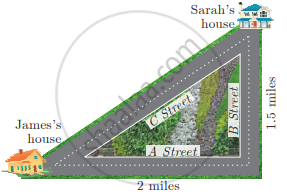
There are two paths that one can choose to go from Sarah’s house to James's house. One way is to take C street, and the other way requires to take B street and then A street. How much shorter is the direct path along C street?
Is the triangle with sides 25 cm, 5 cm and 24 cm a right triangle? Give reasons for your answer.
If S is a point on side PQ of a ΔPQR such that PS = QS = RS, then ______.
