Advertisements
Advertisements
प्रश्न
Find the Pythagorean triplet from among the following set of numbers.
9, 40, 41
Advertisements
उत्तर
The given set of numbers is (9, 40, 41).
We use the Pythagorean theorem:
Hypotenuse2 = Base2 + Height2
∴ 412 = 92 + 402
1681 = 81 + 1600
∴ 412 = 1681
Since 412= 1681, the Pythagorean theorem holds true.
Thus, (9, 40, 41) forms a Pythagorean triplet.
संबंधित प्रश्न
Prove that the points A(0, −1), B(−2, 3), C(6, 7) and D(8, 3) are the vertices of a rectangle ABCD?
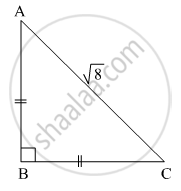
For finding AB and BC with the help of information given in the figure, complete following activity.
AB = BC .......... 
∴ ∠BAC =
∴ AB = BC = × AC
= × `sqrt8`
= × `2sqrt2`
=
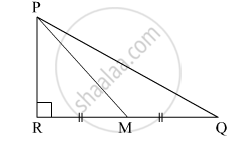
In the given figure, M is the midpoint of QR. ∠PRQ = 90°. Prove that, PQ2 = 4PM2 – 3PR2.
In equilateral Δ ABC, AD ⊥ BC and BC = x cm. Find, in terms of x, the length of AD.
O is any point inside a rectangle ABCD.
Prove that: OB2 + OD2 = OC2 + OA2.
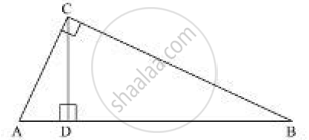
In the following Figure ∠ACB= 90° and CD ⊥ AB, prove that CD2 = BD × AD
In a triangle ABC, AC > AB, D is the midpoint BC, and AE ⊥ BC. Prove that: AB2 = AD2 - BC x CE + `(1)/(4)"BC"^2`
If length of sides of a triangle are a, b, c and a2 + b2 = c2, then which type of triangle it is?
Two trees 7 m and 4 m high stand upright on a ground. If their bases (roots) are 4 m apart, then the distance between their tops is ______.
Two angles are said to be ______, if they have equal measures.
