Advertisements
Advertisements
प्रश्न
Find the Pythagorean triplet from among the following set of numbers.
2, 6, 7
Advertisements
उत्तर
It is known that, if in a triplet of natural numbers, the square of the biggest number is equal to the sum of the squares of the other two numbers, then the three numbers form a Pythagorean triplet.
The given set of numbers is (2, 6, 7).
The biggest number among the given set is 7.
72 = 49; 62 = 36; 22 = 4
Now, 4 + 36 = 40 ≠ 49
∴ 22 + 62 ≠ 72
Thus, (2, 6, 7) does not form a Pythagorean triplet.
संबंधित प्रश्न
From a point O in the interior of a ∆ABC, perpendicular OD, OE and OF are drawn to the sides BC, CA and AB respectively. Prove
that :
`(i) AF^2 + BD^2 + CE^2 = OA^2 + OB^2 + OC^2 – OD^2 – OE^2 – OF^2`
`(ii) AF^2 + BD^2 + CE^2 = AE^2 + CD^2 + BF^2`
ABC is an isosceles triangle right angled at C. Prove that AB2 = 2AC2
Prove that the points A(0, −1), B(−2, 3), C(6, 7) and D(8, 3) are the vertices of a rectangle ABCD?
In ΔABC, ∠B = 90°. Find the sides of the triangle if:
- AB = (x − 3) cm, BC = (x + 4) cm and AC = (x + 6) cm
- AB = x cm, BC = (4x + 4) cm and AC = (4x + 5) cm
If the sides of the triangle are in the ratio 1: `sqrt2`: 1, show that is a right-angled triangle.
In an isosceles triangle ABC; AB = AC and D is the point on BC produced.
Prove that: AD2 = AC2 + BD.CD.
Choose the correct alternative:
In right-angled triangle PQR, if hypotenuse PR = 12 and PQ = 6, then what is the measure of ∠P?
In the right-angled ∆PQR, ∠ P = 90°. If l(PQ) = 24 cm and l(PR) = 10 cm, find the length of seg QR.
In the given figure, ∠T and ∠B are right angles. If the length of AT, BC and AS (in centimeters) are 15, 16, and 17 respectively, then the length of TC (in centimeters) is ______.

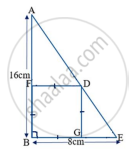
Sides AB and BE of a right triangle, right-angled at B are of lengths 16 cm and 8 cm respectively. The length of the side of largest square FDGB that can be inscribed in the triangle ABE is ______.