Advertisements
Advertisements
प्रश्न
Find the Pythagorean triplet from among the following set of numbers.
4, 5, 6
Advertisements
उत्तर
It is known that, if in a triplet of natural numbers, the square of the biggest number is equal to the sum of the squares of the other two numbers, then the three numbers form a Pythagorean triplet.
The given set of numbers is (4, 5, 6).
The biggest number among the given set is 6.
62 = 36; 52 = 25; 42 = 16
Now, 25 + 16 = 41 ≠ 36
∴ 52 + 42 ≠ 62
Thus, (4, 5, 6) does not form a Pythagorean triplet.
संबंधित प्रश्न
In a right triangle ABC right-angled at C, P and Q are the points on the sides CA and CB respectively, which divide these sides in the ratio 2 : 1. Prove that
`(i) 9 AQ^2 = 9 AC^2 + 4 BC^2`
`(ii) 9 BP^2 = 9 BC^2 + 4 AC^2`
`(iii) 9 (AQ^2 + BP^2 ) = 13 AB^2`
The perpendicular AD on the base BC of a ∆ABC intersects BC at D so that DB = 3 CD. Prove that `2"AB"^2 = 2"AC"^2 + "BC"^2`
D and E are points on the sides CA and CB respectively of a triangle ABC right angled at C. Prove that AE2 + BD2 = AB2 + DE2
In ∆ ABC, AD ⊥ BC.
Prove that AC2 = AB2 +BC2 − 2BC x BD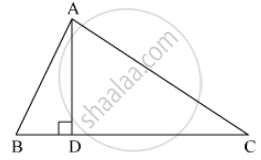
In triangle PQR, angle Q = 90°, find: PR, if PQ = 8 cm and QR = 6 cm
Find the Pythagorean triplet from among the following set of numbers.
3, 4, 5
Find the length of the perpendicular of a triangle whose base is 5cm and the hypotenuse is 13cm. Also, find its area.
A 5 m long ladder is placed leaning towards a vertical wall such that it reaches the wall at a point 4 m high. If the foot of the ladder is moved 1.6 m towards the wall, then find the distance by which the top of the ladder would slide upwards on the wall.
Prove that the area of the equilateral triangle drawn on the hypotenuse of a right angled triangle is equal to the sum of the areas of the equilateral triangles drawn on the other two sides of the triangle.
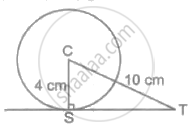
In the adjoining figure, a tangent is drawn to a circle of radius 4 cm and centre C, at the point S. Find the length of the tangent ST, if CT = 10 cm.