Advertisements
Advertisements
Question
Find the Pythagorean triplet from among the following set of numbers.
4, 5, 6
Advertisements
Solution
It is known that, if in a triplet of natural numbers, the square of the biggest number is equal to the sum of the squares of the other two numbers, then the three numbers form a Pythagorean triplet.
The given set of numbers is (4, 5, 6).
The biggest number among the given set is 6.
62 = 36; 52 = 25; 42 = 16
Now, 25 + 16 = 41 ≠ 36
∴ 52 + 42 ≠ 62
Thus, (4, 5, 6) does not form a Pythagorean triplet.
RELATED QUESTIONS
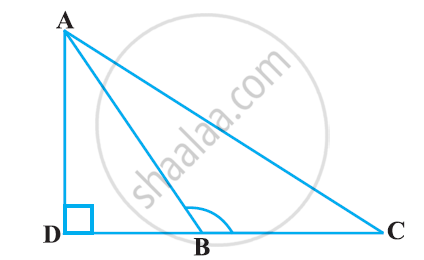
In the given figure, ABC is a triangle in which ∠ABC> 90° and AD ⊥ CB produced. Prove that AC2 = AB2 + BC2 + 2BC.BD.
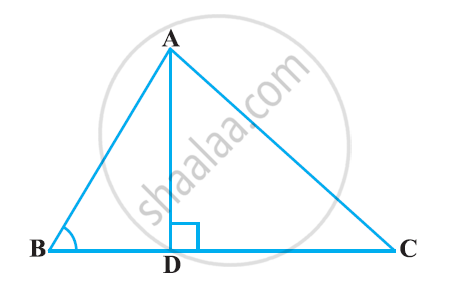
In the given figure, ABC is a triangle in which ∠ABC < 90° and AD ⊥ BC. Prove that AC2 = AB2 + BC2 − 2BC.BD.
In the following figure, AD is perpendicular to BC and D divides BC in the ratio 1: 3.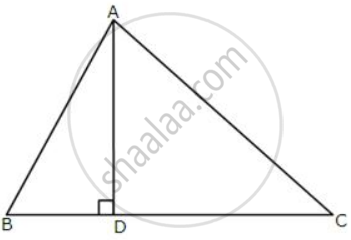
Prove that : 2AC2 = 2AB2 + BC2
In the figure, given below, AD ⊥ BC.
Prove that: c2 = a2 + b2 - 2ax.
In the following Figure ∠ACB= 90° and CD ⊥ AB, prove that CD2 = BD × AD
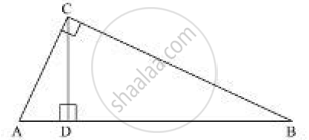
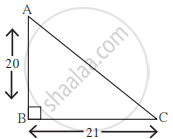
From the given figure, find the length of hypotenuse AC and the perimeter of ∆ABC.
PQR is an isosceles triangle with PQ = PR = 10 cm and QR = 12 cm. Find the length of the perpendicular from P to QR.
If ‘l‘ and ‘m’ are the legs and ‘n’ is the hypotenuse of a right angled triangle then, l2 = ________
If two legs of a right triangle are equal to two legs of another right triangle, then the right triangles are congruent.
If the hypotenuse of one right triangle is equal to the hypotenuse of another right triangle, then the triangles are congruent.
