Advertisements
Advertisements
प्रश्न
The perpendicular AD on the base BC of a ∆ABC intersects BC at D so that DB = 3 CD. Prove that `2"AB"^2 = 2"AC"^2 + "BC"^2`
Advertisements
उत्तर १
We have
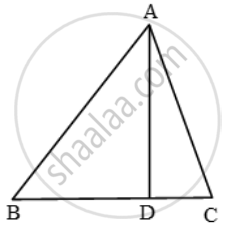
DB = 3CD
BC = BD + DC
The perpendicular AD on the base BC of a ∆ABC intersects BC at D so that DB = 3 CD. Prove that 2AC2 + BC2.
We have,
DB = 3CD
∴ BC = BD + DC
⇒ BC = 3 CD + CD
`⇒ BD = 4 CD ⇒ CD = \frac { 1 }{ 4 } BC`
`∴ CD = \frac { 1 }{ 4 } BC and BD = 3CD = \frac { 1 }{ 4 } BC ….(i)`
Since ∆ABD is a right triangle right-angled at D.
`∴ AB^2 = AD^2 + BD^2 ….(ii)`
Similarly, ∆ACD is a right triangle right angled at D.
`∴ AC^2 = AD^2 + CD^2 ….(iii)`
Subtracting equation (iii) from equation (ii) we get
`AB^2 – AC^2 = BD^2 – CD^2`
`⇒ AB^2 – AC^2 = ( \frac{3}{4}BC)^{2}-( \frac{1}{4}BC)^{2}[`
`⇒ AB^2 – AC^2 = \frac { 9 }{ 16 } BC^2 – \frac { 1 }{ 16 } BC^2`
`⇒ AB^2 – AC^2 = \frac { 1 }{ 2 } BC^2`
`⇒ 2(AB^2 – AC^2 ) = BC^2`
`⇒ 2AB^2 = 2AC^2 + BC^2`
उत्तर २
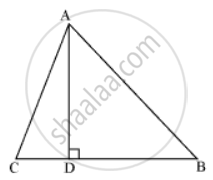
In ΔACD
AC2 = AD2 + DC2
AD2 = AC2 - DC2 ...(1)
In ΔABD
AB2 = AD2 + DB2
AD2 = AB2 - DB2 ...(2)
From equation (1) and (2)
Therefore AC2 - DC2 = AB2 - DB2
since given that 3DC = DB
DC = `"BC"/(4) and "DB" = (3"BC")/(4)`
`"AC"^2 - ("BC"/4)^2 = "AB"^2 - ((3"BC")/4)^2`
`"AC"^2 - "Bc"^2/(16) = "AB"^2 - (9"BC"^2)/(16)`
16AC2 - BC2 = 16AB2 - 9BC2
⇒ 16AB2 - 16AC2 = 8BC2
⇒ 2AB2 = 2AC2 + BC2.
APPEARS IN
संबंधित प्रश्न
In triangle ABC, ∠C=90°. Let BC= a, CA= b, AB= c and let 'p' be the length of the perpendicular from 'C' on AB, prove that:
1. cp = ab
2. `1/p^2=1/a^2+1/b^2`
ABC is a right-angled triangle, right-angled at A. A circle is inscribed in it. The lengths of the two sides containing the right angle are 5 cm and 12 cm. Find the radius of the circle
ABC is an isosceles triangle right angled at C. Prove that AB2 = 2AC2
Nazima is fly fishing in a stream. The tip of her fishing rod is 1.8 m above the surface of the water and the fly at the end of the string rests on the water 3.6 m away and 2.4 m from a point directly under the tip of the rod. Assuming that her string (from the tip of her rod to the fly) is taut, ho much string does she have out (see Figure)? If she pulls in the string at the rate of 5 cm per second, what will be the horizontal distance of the fly from her after 12 seconds?

The perimeter of a triangle with vertices (0, 4), (0, 0) and (3, 0) is
(A)\[7 + \sqrt{5}\]
(B) 5
(C) 10
(D) 12
In ΔABC, Find the sides of the triangle, if:
- AB = ( x - 3 ) cm, BC = ( x + 4 ) cm and AC = ( x + 6 ) cm
- AB = x cm, BC = ( 4x + 4 ) cm and AC = ( 4x + 5) cm
In triangle ABC, AB = AC = x, BC = 10 cm and the area of the triangle is 60 cm2.
Find x.
In triangle ABC, AB = AC and BD is perpendicular to AC.
Prove that: BD2 − CD2 = 2CD × AD
In equilateral Δ ABC, AD ⊥ BC and BC = x cm. Find, in terms of x, the length of AD.
In an isosceles triangle ABC; AB = AC and D is the point on BC produced.
Prove that: AD2 = AC2 + BD.CD.
A boy first goes 5 m due north and then 12 m due east. Find the distance between the initial and the final position of the boy.
A ladder 15m long reaches a window which is 9m above the ground on one side of a street. Keeping its foot at the same point, the ladder is turned to other side of the street to reach a window 12m high. Find the width of the street.
In ΔABC, AD is perpendicular to BC. Prove that: AB2 + CD2 = AC2 + BD2
In a triangle ABC, AC > AB, D is the midpoint BC, and AE ⊥ BC. Prove that: AB2 = AD2 - BC x CE + `(1)/(4)"BC"^2`
In a square PQRS of side 5 cm, A, B, C and D are points on sides PQ, QR, RS and SP respectively such as PA = PD = RB = RC = 2 cm. Prove that ABCD is a rectangle. Also, find the area and perimeter of the rectangle.
Find the unknown side in the following triangles
Is the triangle with sides 25 cm, 5 cm and 24 cm a right triangle? Give reasons for your answer.
The perimeter of the rectangle whose length is 60 cm and a diagonal is 61 cm is ______.
A right-angled triangle may have all sides equal.
If two legs of a right triangle are equal to two legs of another right triangle, then the right triangles are congruent.
