Advertisements
Advertisements
प्रश्न
PQR is a triangle right angled at P. If PQ = 10 cm and PR = 24 cm, find QR.
Advertisements
उत्तर
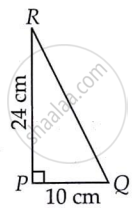
By applying Pythagoras theorem in ΔPQR,
(PQ)2 + (PR)2 = (RQ)2
(10)2 + (24)2 = RQ2
100 + 576 = (QR)2
676 = (QR)2
QR = 26 cm
संबंधित प्रश्न
The diagonal of a rectangular field is 16 metres more than the shorter side. If the longer side is 14 metres more than the shorter side, then find the lengths of the sides of the field.
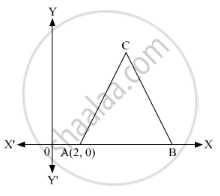
In the given figure, ∆ABC is an equilateral triangle of side 3 units. Find the coordinates of the other two vertices ?
Digonals of parallelogram WXYZ intersect at point O. If OY =5, find WY.
In figure AB = BC and AD is perpendicular to CD.
Prove that: AC2 = 2BC. DC.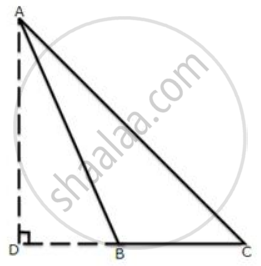
O is any point inside a rectangle ABCD.
Prove that: OB2 + OD2 = OC2 + OA2.
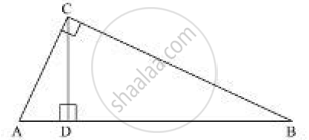
In the following Figure ∠ACB= 90° and CD ⊥ AB, prove that CD2 = BD × AD
If the angles of a triangle are 30°, 60°, and 90°, then shown that the side opposite to 30° is half of the hypotenuse, and the side opposite to 60° is `sqrt(3)/2` times of the hypotenuse.
To get from point A to point B you must avoid walking through a pond. You must walk 34 m south and 41 m east. To the nearest meter, how many meters would be saved if it were possible to make a way through the pond?
In a right angled triangle, the hypotenuse is the greatest side
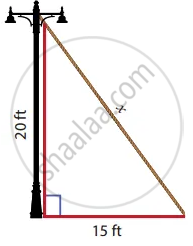
Find the length of the support cable required to support the tower with the floor