Advertisements
Advertisements
Question
PQR is a triangle right angled at P. If PQ = 10 cm and PR = 24 cm, find QR.
Advertisements
Solution
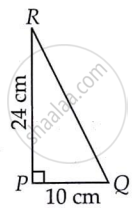
By applying Pythagoras theorem in ΔPQR,
(PQ)2 + (PR)2 = (RQ)2
(10)2 + (24)2 = RQ2
100 + 576 = (QR)2
676 = (QR)2
QR = 26 cm
RELATED QUESTIONS
In a right triangle ABC, right-angled at B, BC = 12 cm and AB = 5 cm. The radius of the circle inscribed in the triangle (in cm) is ______.
In Figure ABD is a triangle right angled at A and AC ⊥ BD. Show that AC2 = BC × DC
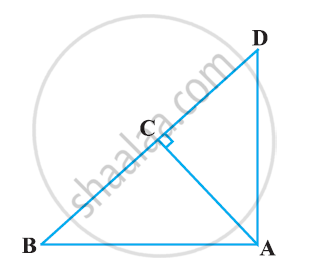
ABC is an isosceles triangle right angled at C. Prove that AB2 = 2AC2
A guy wire attached to a vertical pole of height 18 m is 24 m long and has a stake attached to the other end. How far from the base of the pole should the stake be driven so that the wire will be taut?
In the given figure, ABC is a triangle in which ∠ABC> 90° and AD ⊥ CB produced. Prove that AC2 = AB2 + BC2 + 2BC.BD.
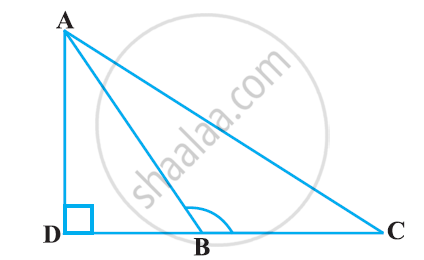
The given figure shows a quadrilateral ABCD in which AD = 13 cm, DC = 12 cm, BC = 3 cm and ∠ABD = ∠BCD = 90o. Calculate the length of AB.
In the following figure, AD is perpendicular to BC and D divides BC in the ratio 1: 3.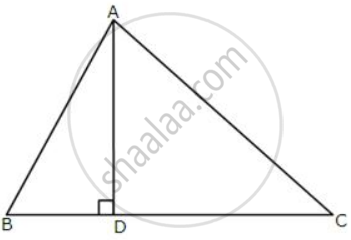
Prove that : 2AC2 = 2AB2 + BC2
Find the length of the hypotenuse of a triangle whose other two sides are 24cm and 7cm.
To get from point A to point B you must avoid walking through a pond. You must walk 34 m south and 41 m east. To the nearest meter, how many meters would be saved if it were possible to make a way through the pond?
In the given figure, AD is a median of a triangle ABC and AM ⊥ BC. Prove that:
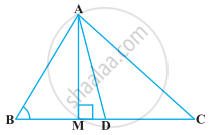
(i) `"AC"^2 = "AD"^2 + "BC"."DM" + (("BC")/2)^2`
(ii) `"AB"^2 = "AD"^2 - "BC"."DM" + (("BC")/2)^2`
(iii) `"AC"^2 + "AB"^2 = 2"AD"^2 + 1/2"BC"^2`
