Advertisements
Advertisements
Question
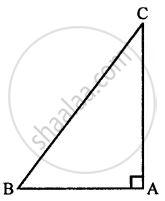
In the given figure, angle BAC = 90°, AC = 400 m, and AB = 300 m. Find the length of BC.
Advertisements
Solution
AC = 400 m
AB = 300 m
BC =?

According to Pythagoras Theorem,
BC2 = AB2 + AC2
BC2 = (300)2 + (400)2
BC2 = 90000 + 160000
BC2 = 250000
BC =`sqrt250000` = 500 m
APPEARS IN
RELATED QUESTIONS
Prove that, in a right-angled triangle, the square of the hypotenuse is equal to the sum of the square of remaining two sides.
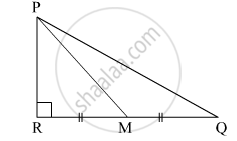
In the given figure, M is the midpoint of QR. ∠PRQ = 90°. Prove that, PQ2 = 4PM2 – 3PR2.
AD is drawn perpendicular to base BC of an equilateral triangle ABC. Given BC = 10 cm, find the length of AD, correct to 1 place of decimal.
In equilateral Δ ABC, AD ⊥ BC and BC = x cm. Find, in terms of x, the length of AD.
The sides of a certain triangle is given below. Find, which of them is right-triangle
6 m, 9 m, and 13 m
In the right-angled ∆PQR, ∠ P = 90°. If l(PQ) = 24 cm and l(PR) = 10 cm, find the length of seg QR.
PQR is an isosceles triangle with PQ = PR = 10 cm and QR = 12 cm. Find the length of the perpendicular from P to QR.
An isosceles triangle has equal sides each 13 cm and a base 24 cm in length. Find its height
In triangle ABC, line I, is a perpendicular bisector of BC.
If BC = 12 cm, SM = 8 cm, find CS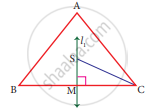
Points A and B are on the opposite edges of a pond as shown in the following figure. To find the distance between the two points, the surveyor makes a right-angled triangle as shown. Find the distance AB.

