Advertisements
Advertisements
Question
The sides of a certain triangle is given below. Find, which of them is right-triangle
6 m, 9 m, and 13 m
Advertisements
Solution
6 m, 9 m, and 13 m
The given triangle will be a right-angled triangle if the square of its largest side is equal to the sum of the squares on the other two sides.
i.e., If (13)2 = (9)2 + (6)2
169 = 81 + 36 = 169 ≠ 117
So, the given triangle is not right-angled.
APPEARS IN
RELATED QUESTIONS
An aeroplane leaves an airport and flies due north at a speed of 1,000 km per hour. At the same time, another aeroplane leaves the same airport and flies due west at a speed of 1,200 km per hour. How far apart will be the two planes after `1 1/2` hours?
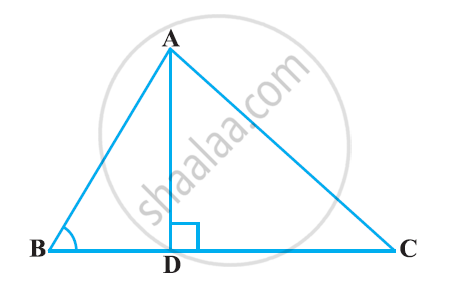
In the given figure, ABC is a triangle in which ∠ABC < 90° and AD ⊥ BC. Prove that AC2 = AB2 + BC2 − 2BC.BD.
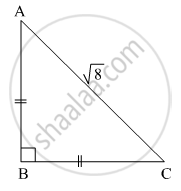
For finding AB and BC with the help of information given in the figure, complete following activity.
AB = BC .......... 
∴ ∠BAC =
∴ AB = BC = × AC
= × `sqrt8`
= × `2sqrt2`
=
Walls of two buildings on either side of a street are parallel to each other. A ladder 5.8 m long is placed on the street such that its top just reaches the window of a building at the height of 4 m. On turning the ladder over to the other side of the street, its top touches the window of the other building at a height 4.2 m. Find the width of the street.
Prove that `(sin θ + cosec θ)^2 + (cos θ + sec θ)^2 = 7 + tan^2 θ + cot^2 θ`.
Prove that (1 + cot A - cosec A ) (1 + tan A + sec A) = 2
Triangle ABC is right-angled at vertex A. Calculate the length of BC, if AB = 18 cm and AC = 24 cm.
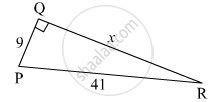
In the figure below, find the value of 'x'.
A right triangle has hypotenuse p cm and one side q cm. If p - q = 1, find the length of third side of the triangle.
A 5 m long ladder is placed leaning towards a vertical wall such that it reaches the wall at a point 4 m high. If the foot of the ladder is moved 1.6 m towards the wall, then find the distance by which the top of the ladder would slide upwards on the wall.
