Advertisements
Advertisements
Question
Find the unknown side in the following triangles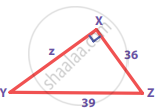
Advertisements
Solution
From ΔXYZ, by Pythagoras theorem,
= YZ2 = XY2 + XZ2
⇒ XY2 = YZ2 – XZ2
Z2 = 392 – 362
= 1521 – 1296
= 225 = 152
z2 = 152
⇒ z = 15
APPEARS IN
RELATED QUESTIONS
In triangle ABC, ∠C=90°. Let BC= a, CA= b, AB= c and let 'p' be the length of the perpendicular from 'C' on AB, prove that:
1. cp = ab
2. `1/p^2=1/a^2+1/b^2`
A man goes 10 m due east and then 24 m due north. Find the distance from the starting point
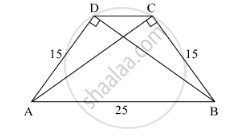
In a trapezium ABCD, seg AB || seg DC seg BD ⊥ seg AD, seg AC ⊥ seg BC, If AD = 15, BC = 15 and AB = 25. Find A(▢ABCD)
If the sides of the triangle are in the ratio 1: `sqrt2`: 1, show that is a right-angled triangle.
Prove that in a right angle triangle, the square of the hypotenuse is equal to the sum of squares of the other two sides.
A right triangle has hypotenuse p cm and one side q cm. If p - q = 1, find the length of third side of the triangle.
∆ABC is right-angled at C. If AC = 5 cm and BC = 12 cm. find the length of AB.
Prove that the area of the equilateral triangle drawn on the hypotenuse of a right angled triangle is equal to the sum of the areas of the equilateral triangles drawn on the other two sides of the triangle.
In a right-angled triangle ABC, if angle B = 90°, BC = 3 cm and AC = 5 cm, then the length of side AB is ______.
Two squares are congruent, if they have same ______.
